PPI (Producer Price Index)
The Producer Price Index measures inflation at the factory gate, before it reaches the shops — which makes it an early warning for the CPI you feel as a consumer. Learn input vs output PPI, the inflation pipeline, why PPI leads CPI, and how investors read it.
Written by James Lipyeat · Founder, Ironclad Research
Reviewed 23 July 2026 · Editorial policy
Before this, read
Introduction
If CPI is the inflation you feel at the till, the Producer Price Index (PPI) is the inflation brewing one step upstream — at the factory gate, before it ever reaches a shop shelf.
PPI is less famous than CPI, but professional investors watch it closely for one reason: it often moves first. Prices tend to travel down a supply chain, from raw materials to manufacturers to retailers to you. Catch a surge in producer costs early, and you get a hint of the consumer inflation — and the interest-rate response — that may follow. This short guide explains what PPI captures, how it differs from CPI, and how to read it as an early-warning gauge.
Quick Definition
The Producer Price Index (PPI) measures the change over time in the prices producers pay for their inputs and receive for their outputs — inflation at the wholesale, factory-gate level, before the consumer stage measured by CPI.
Input vs Output PPI
PPI comes in two halves, and the distinction is the whole point:
- Input prices — what producers pay for the materials, components and energy that go into making things: crude oil, metals, imported parts, electricity. These are highly sensitive to global commodity markets and exchange rates.
- Output prices — what producers charge for their finished goods as they leave the factory: the "factory-gate" price.
The relationship between the two is revealing. When input prices rise faster than output prices, producers are absorbing costs and their margins are being squeezed — a sign they may either accept thinner profits or push prices up later. When output rises in step with input, producers are successfully passing costs along, and those costs are heading toward the consumer.
The Inflation Pipeline
Think of inflation as flowing through a pipeline, with PPI sitting upstream of CPI.
Because of this flow, a sharp rise in PPI input prices — say, from an oil shock — is a reasonable early signal that consumer inflation may climb in the months ahead. Investors and central bankers watch PPI partly to anticipate CPI before it arrives.
Why PPI Leads — But Doesn't Dictate — CPI
"Leading indicator" does not mean "perfect predictor". The link between PPI and CPI is real but loose, for several reasons:
- Partial pass-through. Producers cannot always pass higher costs on. If demand is weak or competition fierce, they absorb the hit, and the PPI rise never fully reaches CPI.
- Services dominate CPI. Modern consumer spending is heavily weighted toward services — rent, haircuts, insurance, streaming — which PPI's goods-heavy focus captures poorly. A lot of what drives CPI simply isn't in the producer-goods pipeline.
- Timing is variable. The lag between a PPI move and any CPI echo ranges from weeks to many months, and sometimes fades entirely.
So PPI is best read as pressure in the pipe, not a countdown timer. Rising producer costs raise the odds of consumer inflation later; they don't guarantee it.
How Investors Use PPI
- An early read on the inflation trend. A turn in PPI can precede a turn in CPI, giving a slightly earlier view of where price pressure is heading — and therefore where interest rates may go.
- A margin signal for companies. The input-versus-output gap is a live readout on corporate profit margins. Input prices outrunning output prices warn of a margin squeeze across manufacturers — useful when analysing industrial and consumer-goods shares.
- A cross-check on CPI. When CPI surprises, PPI helps judge whether the move is a durable trend building through the supply chain or a one-off blip.
Common Misconceptions
"PPI and CPI always move together." They are related but frequently diverge, especially when producers absorb costs or when services (absent from goods PPI) drive consumer inflation.
"Rising PPI guarantees rising CPI." It raises the probability, not a certainty. Weak demand and competition can break the pass-through entirely.
"PPI is about producers' profits." No — it measures the prices producers pay and charge, not their profits. The gap between input and output prices hints at margins, but PPI itself is a price index.
Real-World Application
Suppose global oil and metal prices jump, and the ONS reports input PPI up 6% while output PPI is up only 2%. What does an investor read into it?
First, a warning light for future consumer inflation: costs are building in the pipeline, so CPI may drift higher in coming months, keeping pressure on the central bank to hold rates high. Second, a margin story: manufacturers are absorbing much of the cost rise (input up far more than output), which threatens profits in industrial and consumer-goods sectors and may eventually force price rises to protect margins. Neither is a trading trigger on its own, but together they sharpen the picture that a bare CPI headline can't provide — exactly why PPI earns its place on the professional's dashboard.
Key Takeaways
- PPI measures inflation at the producer, factory-gate level — one step upstream of the consumer prices in CPI.
- Input PPI is what producers pay for materials and energy; output PPI is what they charge for finished goods. The gap signals margin pressure.
- Because prices flow downstream, PPI can lead CPI — an early warning of consumer inflation to come.
- The link is real but loose: pass-through is partial, services dominate CPI, and timing varies. Read PPI as pressure in the pipe, not a countdown.
- Investors use PPI to anticipate the inflation trend, gauge corporate margins, and cross-check surprising CPI prints.
Finished this lesson? Track your progress.
Key terms
Next lesson
Continue learning
Interest Rates
Related topics
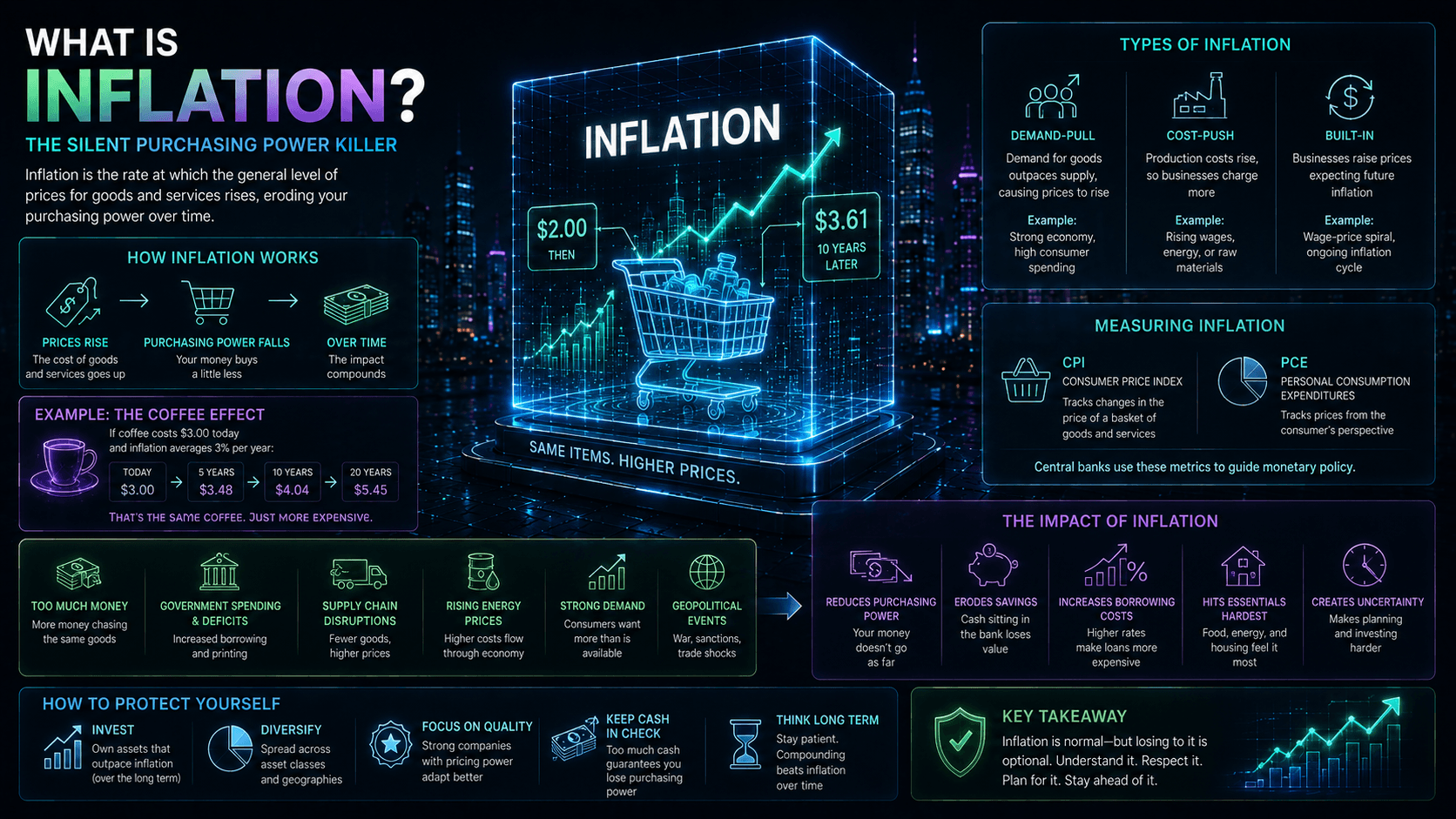
Inflation
Why the slow rise in prices is the quiet force every investor must beat: what inflation is, how it's measured, the difference between real and nominal returns, how it erodes idle cash, and how different assets hold up against it.
GDP (Gross Domestic Product)
Gross Domestic Product is the single number that sums up the size of an economy. Learn the three ways it's measured, the crucial difference between real and nominal GDP, what growth and contraction mean, how it defines a recession, why investors track it — and the important things it leaves out.
Ironclad Research provides educational content only. Nothing on this platform is financial advice, a recommendation, or an offer to buy or sell any security. Always do your own research and consider professional advice before making financial decisions.