Inflation
Why the slow rise in prices is the quiet force every investor must beat: what inflation is, how it's measured, the difference between real and nominal returns, how it erodes idle cash, and how different assets hold up against it.
Written by James Lipyeat · Founder, Ironclad Research
Reviewed 23 July 2026 · Editorial policy
Before this, read
Introduction
There is a quiet force working against your money every single day, whether you notice it or not. It doesn't crash the markets or make headlines most of the time. It simply, slowly, makes everything cost a little more — and in doing so, makes the money in your pocket worth a little less. That force is inflation, and understanding it is essential, because inflation is the hurdle every investor must clear just to stand still.
This lesson explains what inflation is, what causes it, how it is measured, and — most importantly for an investor — the crucial difference between nominal and real returns. We will see why idle cash quietly loses value, why even small inflation rates compound into large effects over time, and how different assets have historically fared against it. It builds on What Is Investing? (where inflation first appeared as the reason investing exists) and leads naturally into Compound Growth.
Quick Definition
Inflation is the general rise in prices across an economy over time, which reduces the purchasing power of money — each dollar buys a little less than it did before.
The key phrase is purchasing power. Inflation isn't really about prices going up in isolation; it's about money going down in value. If a loaf of bread cost $1 last year and $1.03 this year, that 3% rise means your dollar now buys less bread. Multiply that across everything you buy, and you have inflation: the steady weakening of what your money can actually command in goods and services.
What Causes Inflation
Inflation has several causes, which are explored more fully in the Economics curriculum, but in brief:
- Demand-pull — when demand for goods and services outstrips supply, prices rise as buyers compete for limited goods.
- Cost-push — when the cost of producing things rises (energy, wages, raw materials), businesses pass those costs on as higher prices.
- Money supply — when the amount of money in an economy grows faster than the goods available to buy, more money chases the same goods, pushing prices up.
A small, steady amount of inflation is generally considered normal and even healthy for an economy — most central banks deliberately target around 2% a year. Problems arise at the extremes: very high inflation erodes savings rapidly and destabilises planning, while deflation (falling prices) brings its own dangers. For the investor, what matters most is not the precise cause but the effect: a persistent headwind against the value of money.
The Silent Erosion Of Cash
The most important consequence of inflation for a saver is what it does to idle cash. Money left in a non-interest account, or earning less than inflation, loses real value year after year — invisibly, because the number on the statement never falls.
This is why holding large amounts of cash for the long term, while it feels safe, is quietly risky. The balance is stable, but its value is melting. At a typical 3% inflation rate, money loses roughly half its purchasing power in about 23 years. Cash has its place — for emergencies and short-term needs, its stability is exactly what you want — but as a long-term store of wealth, it is a slow-motion loss. This single fact is the deepest reason investing exists: to put money into assets that can at least keep pace with, and ideally outgrow, the rising tide of prices.
How Inflation Is Measured
Inflation is tracked by measuring the price of a representative "basket" of goods and services that a typical household buys — food, housing, transport, energy, and so on — and seeing how that total cost changes over time. The most common measure is the Consumer Price Index (CPI), which many countries publish monthly.
If the basket cost $1,000 last year and $1,030 this year, CPI inflation is 3%. Because the basket is an average, your personal inflation rate may differ — someone spending heavily on a category that's rising fast (say, energy) experiences more inflation than the headline figure. Still, CPI is the standard yardstick, used by central banks to set policy and by investors to judge whether their returns are actually getting ahead. (CPI and related measures are covered in detail in the Economics curriculum.)
Real vs Nominal Returns
Here is the concept that turns inflation from an abstract worry into a practical investing tool: the distinction between nominal and real returns.
Nominal return is the headline percentage gain on your money. Real return is what's left after subtracting inflation — the change in your actual purchasing power.
The rough relationship is simple: real return ≈ nominal return − inflation. This small adjustment changes everything, because only the real return tells you whether you are genuinely getting wealthier.
Consider a savings account paying 2% interest while inflation runs at 4%. The nominal return is positive — your balance grows by 2% — but your real return is about minus 2%: you have more dollars, yet they buy less than before. Now consider a portfolio returning 8% in the same environment: its real return is about 4%, a genuine increase in what your money can buy. This is why savvy investors always think in real terms. A headline return that fails to beat inflation is, in the only sense that matters, a loss. Inflation sets the hurdle rate — the minimum return you must earn just to preserve your wealth.
How Different Assets Fare Against Inflation
If inflation is the hurdle, which assets tend to clear it? History offers a rough ranking, though never a guarantee.
- Equities (shares) have historically been among the best long-term inflation-beaters. Companies can raise their prices as costs rise, growing revenues and profits roughly in line with — or ahead of — inflation, which lifts share values and dividends over time. You own a slice of businesses whose nominal output rises with the price level.
- Real assets such as property and certain commodities can also hold value, since their prices often rise with the general price level.
- Bonds are more vulnerable: a conventional bond pays fixed interest, so unexpected inflation erodes the real value of those fixed payments (though inflation-linked bonds exist to address this).
- Cash is the most exposed of all — its near-zero growth almost guarantees a real loss when inflation is positive.
The broad lesson reinforces the case for investing: to beat inflation over the long run, you generally need to own productive, growth-oriented assets rather than holding cash. The very volatility that makes equities risky in the short term is the price of their superior ability to outpace inflation over the long term.
Inflation And Interest Rates
Inflation does not exist in isolation — it is tightly linked to interest rates, the price of borrowing money, which central banks adjust largely in response to it. This relationship matters to every investor, so it's worth a brief sketch (the Economics curriculum covers it in full).
When inflation runs too high, central banks typically raise interest rates. Higher rates make borrowing more expensive and saving more attractive, cooling demand and, in time, easing price rises. When inflation is too low or the economy is weak, they cut rates to encourage borrowing and spending. For investors, these moves ripple through everything: higher rates tend to weigh on share and bond prices (future profits are discounted more heavily, and safer savings suddenly compete with riskier assets), while lower rates tend to lift them. This is why markets hang on every central-bank announcement about inflation and rates. The key takeaway for now is that inflation is not just a force eroding your cash — it is also the main lever behind interest-rate changes that move the entire investing landscape, sometimes sharply.
When Inflation Goes Wrong
The moderate, ~2% inflation that central banks target is a feature of a healthy economy. But inflation has dangerous extremes worth understanding, because they show why it is taken so seriously.
At the high end lies hyperinflation — runaway price rises of dozens or hundreds of percent, where money loses value so fast that people rush to spend it the moment they're paid. Historical episodes have wiped out savings, destroyed the value of cash and bonds almost overnight, and caused deep social harm. Such cases are the most extreme illustration of inflation's core lesson: money is only as good as what it can buy, and that can vanish.
At the opposite extreme lies deflation — a sustained fall in prices. It sounds appealing (cheaper everything), but it can be insidious: if people expect prices to keep falling, they delay spending, which weakens the economy, reduces incomes, and can trap a country in a damaging downward spiral. Debt also becomes heavier in real terms. This is why policymakers generally prefer a small positive inflation rate to either extreme — and why "a little inflation" is considered the healthy norm rather than something to be eliminated entirely.
Why Even Small Inflation Compounds
People underestimate inflation because the annual numbers look small. But inflation compounds — it stacks on top of itself year after year, just like investment returns, only working against you.
At 3% a year, prices don't rise 30% over a decade; they rise about 34%, because each year's increase builds on an already-higher base. Over longer periods the effect is dramatic: at 3%, the price level roughly doubles in about 23 years, meaning money loses half its purchasing power. At 5%, that halving happens in about 14 years. This is the mirror image of the compounding that makes investing powerful — and it's why ignoring inflation over a long horizon is so dangerous.
A concrete example makes the stakes vivid. Suppose you decide today that $30,000 a year would fund a comfortable retirement, and you plan to retire in 30 years. At just 3% inflation, you will actually need about $73,000 a year then to buy the same lifestyle — nearly two and a half times as much — purely because of compounding inflation. Someone who plans around today's $30,000 figure, forgetting to adjust for inflation, would find their retirement income falls devastatingly short. This is among the most common and damaging planning errors, and it flows directly from underestimating how a "small" annual rate compounds across a working life. The same force that quietly halves the value of cash is the force that silently raises the bar for every long-term financial goal.
Your personal inflation rate
One nuance worth noting: the headline CPI is an average, and your own experience of inflation depends on what you buy. Someone whose spending is dominated by a category rising faster than average — housing or energy in some periods, for instance — feels more inflation than the published figure, while someone whose costs are weighted toward falling-price categories feels less. There is no need to calculate your personal rate precisely, but it's useful to know that the official number is a guide, not a perfect measure of your own cost of living — and that planning should lean toward caution rather than assuming the headline rate applies exactly to you.
Protecting Against Inflation
The practical defences against inflation follow directly from everything above:
- Don't hold excess cash long-term. Keep enough for emergencies and near-term needs, but recognise that large cash piles bleed real value over years.
- Own growth assets. A diversified portfolio weighted toward equities has historically been the most accessible long-term inflation-beater for ordinary investors.
- Think in real terms. Judge every return against inflation; aim to clear the hurdle rate, not just to see a positive nominal number.
- Consider inflation-linked options where appropriate. Some bonds and savings products are explicitly tied to inflation, offering targeted protection for money that must stay safe.
Common Misconceptions
- "Inflation only matters when it's in the news." It works silently every year; the long-term, compounding erosion matters more than occasional spikes.
- "My savings are safe because the balance never drops." Nominal stability hides real loss — inflation erodes purchasing power even when the number holds.
- "A positive return means I'm getting richer." Only if it beats inflation; a nominal gain below inflation is a real loss.
- "Inflation is always bad." Moderate, steady inflation is normal and targeted by policy; the danger lies at the extremes and in failing to protect long-term money against it.
Real-World Application
Imagine your grandparent kept $10,000 in a drawer in the year 2000 to be "safe." The number never changed — it's still $10,000 today. But because of two decades of inflation, that money now buys roughly what $6,000 or so bought back then; nearly 40% of its purchasing power has silently evaporated. Had the same $10,000 been invested in a diversified portfolio that merely matched typical long-term returns, it would not only have kept pace with inflation but grown substantially in real terms. Same starting amount, opposite outcomes — and the entire difference comes down to understanding that money sitting still doesn't stay still in value; it shrinks. Recognising inflation is what turns "I'll keep it safe in cash" from a comforting instinct into a decision you make with your eyes open.
Key Takeaways
- Inflation is the general rise in prices over time, which steadily erodes the purchasing power of money.
- It is measured by indices like CPI, and central banks typically target a low, steady rate (~2%).
- The key investing distinction is real vs nominal return: real ≈ nominal − inflation, and only real return shows if you're truly getting ahead.
- Cash loses real value over time despite stable balances; inflation sets the hurdle rate every investment must clear.
- Equities and real assets have historically outpaced inflation; cash and conventional bonds are more exposed.
- Inflation compounds, so even small rates cause large losses of purchasing power over decades — a key reason to invest rather than hoard cash.
Finished this lesson? Track your progress.
Frequently asked questions
What is inflation and why does it matter to investors?
Inflation is the general rise in prices across an economy over time, which reduces the purchasing power of money—each unit of currency buys less than it did before. It matters to investors because inflation is a hurdle that every investor must overcome just to maintain their wealth; without returns that at least match inflation, money loses real value over time.
What is the difference between nominal and real returns?
Nominal return is the headline percentage gain on your money, while real return is what's left after subtracting inflation. Only the real return shows whether you are genuinely getting wealthier; for example, a 2% savings rate during 4% inflation gives a real return of about minus 2%, meaning you've actually lost purchasing power despite the positive nominal gain.
How does inflation erode the value of idle cash over time?
Money left in a non-interest account or earning less than inflation loses real value year after year, even though the number on your statement stays the same. At a steady 3% inflation rate, $10,000 of idle cash loses nearly half its real buying power over twenty years—a loss you never see on a statement, which is why holding large amounts of cash long-term, while it feels safe, is quietly risky.
How is inflation measured and what is the Consumer Price Index?
Inflation is measured by tracking the price of a representative 'basket' of goods and services that a typical household buys—food, housing, transport, energy, and so on—and seeing how that total cost changes over time. The Consumer Price Index (CPI) is the most common measure, published monthly by many countries; it serves as the standard yardstick used by central banks and investors to judge whether returns are keeping ahead of inflation.
Why does the article say investing exists?
Investing exists to put money into assets that can at least keep pace with, and ideally outgrow, the rising tide of prices caused by inflation. Without investing, idle cash slowly loses its purchasing power, making it impossible to preserve or grow wealth over the long term.
Key terms
Next lesson
Continue learning
Compound Growth
Related topics
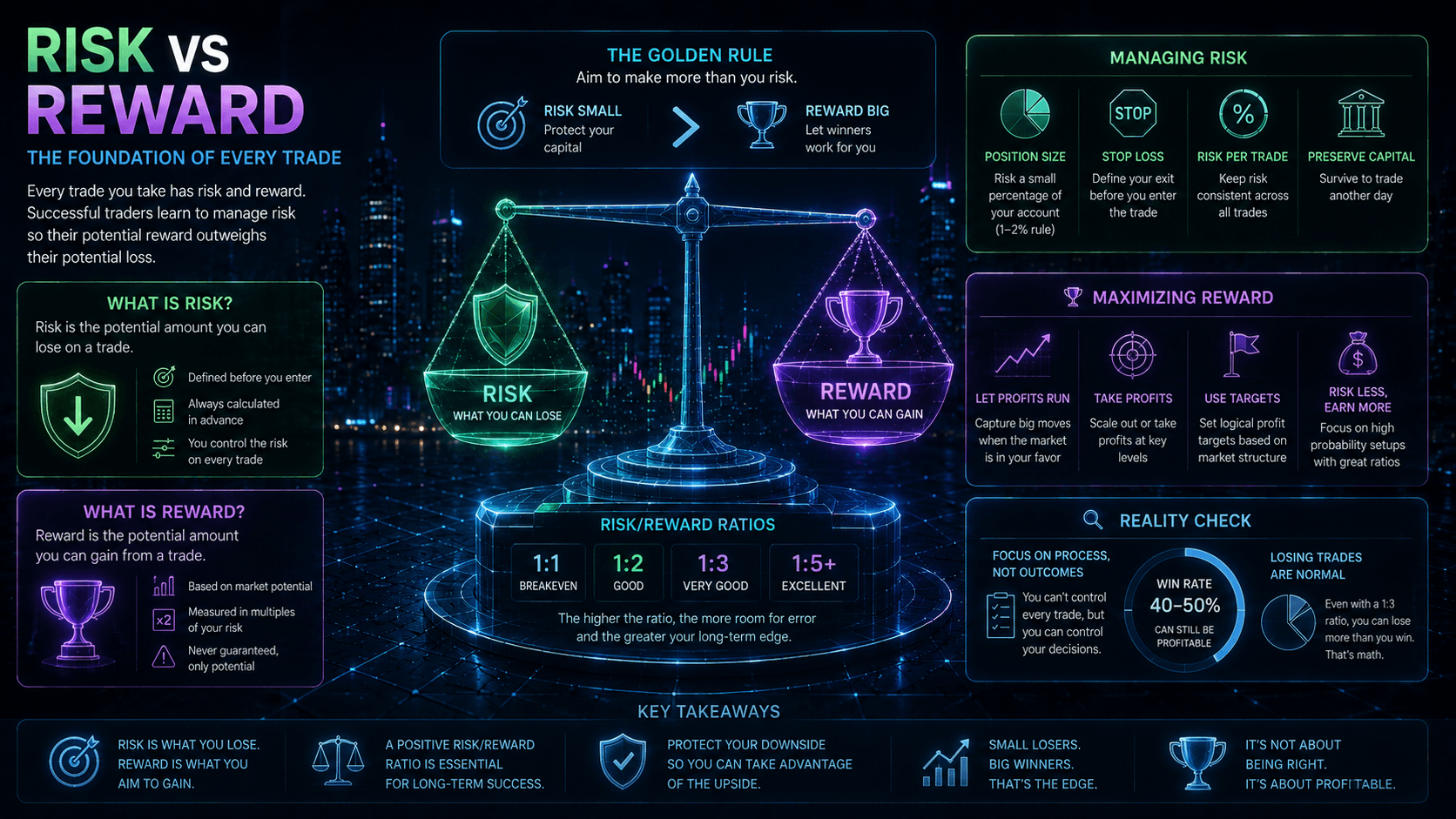
Risk vs Reward
The single most important relationship in finance: why higher potential reward almost always comes with higher risk, how each is measured, the asymmetry of losses, and how to think about the trade-off sensibly.
CPI (Consumer Price Index)
The Consumer Price Index is how a country actually measures inflation. Learn what the 'basket of goods' is, how a national statistics agency builds the number, the difference between headline and core inflation, why central banks target 2%, and why a CPI release can move markets in seconds.
Interest Rates
Interest rates are the price of money, and the single most powerful lever in the economy. Learn what they are, how central banks set them, how a change ripples out to your mortgage, your savings and the stock market, and why almost every asset is repriced when rates move.
Ironclad Research provides educational content only. Nothing on this platform is financial advice, a recommendation, or an offer to buy or sell any security. Always do your own research and consider professional advice before making financial decisions.