What Is Market Structure?
A guide to the hidden plumbing of the markets: the players, how a trade really travels from your tap to settlement, what the order book and liquidity mean, lit venues versus dark pools, and why it all affects the price you get.
Written by James Lipyeat · Founder, Ironclad Research
Reviewed 23 July 2026 · Editorial policy
Before this, read
Introduction
When you look at a stock, you see a single number: the price. It seems to update by magic, ticking up and down on the screen. But behind that one number sits an enormous, fast-moving machine — a global network of exchanges, dealers, brokers, computers and clearing houses, all governed by intricate rules, working in milliseconds to turn buy and sell orders into completed trades.
This machine is called market structure, and most investors never look at it. Yet it quietly shapes everything: the price you actually get, the cost hidden in the spread, the speed of your fill, and even who profits from your order. This lesson lifts the lid. We will meet the key players, follow a single trade from your tap to final settlement, understand the order book and liquidity that determine prices, explore the difference between public "lit" venues and private "dark" ones, and see why all of this matters even to a patient long-term investor. It builds on what you learned about brokers, and it sets up the companion lessons on payment for order flow and direct registration.
Quick Definition
Market structure is the system of venues, participants and rules that determines how trades actually happen — how an order becomes a completed, settled transaction.
If a share price is the what, market structure is the how. It is the plumbing beneath the chart: the arrangement of marketplaces where buyers and sellers meet, the intermediaries who connect them and provide liquidity, and the back-office machinery that confirms, clears and settles every trade. Understanding it transforms the market from a mysterious black box into a comprehensible system.
Why Market Structure Matters
It is tempting to think that, as a long-term investor, the plumbing is irrelevant — you buy, you hold, you ignore the noise. But every time you transact, you pass through this machinery, and its quality affects your outcomes in concrete ways. A wide spread is a real cost. Poor execution shaves pennies — or dollars — off every trade. The venue your order is routed to determines the price you get and who profits from handling it. Over a lifetime of investing, these structural details compound just as returns and fees do.
Beyond your own trades, market structure explains phenomena that otherwise look like conspiracies or chaos: why prices can gap violently, why some firms profit from speed, why "free" trading exists, and why the shares you "own" are wrapped in layers of intermediaries. Knowledge of the structure is what lets you interpret the market accurately rather than through rumour. It is the difference between watching the weather and understanding the climate.
A Brief History: From Floor To Fragments
Today's machinery is the product of a century of evolution, and a quick tour explains why it looks the way it does. For generations, a stock market was a literal place — a grand hall where human brokers shouted orders at one another in a chaotic ritual called "open outcry." A specialist stood at a post for each stock, matching buyers and sellers by hand and maintaining an orderly market. It was slow, opaque and expensive, but it was a single place where a stock's price was discovered.
Two waves of change transformed it. First, electronification in the late twentieth century replaced the trading floor with computer matching engines, collapsing the time to execute a trade from minutes to microseconds. Second, competition and regulation deliberately broke the monopoly of the old exchanges, encouraging new venues to compete for order flow. The result is today's fragmented market: instead of one place where a stock trades, there are now many — multiple exchanges, alternative venues and dark pools, all trading the same shares simultaneously.
This fragmentation brought real benefits — lower costs, faster execution, more competition — but it also made the system vastly more complex. A single stock's liquidity is now scattered across many venues, which is precisely why the routing decision your broker makes, and the rules requiring it to seek the best available price, became so important. The market you trade in today is not one room but a high-speed network of competing rooms.
The Key Players
The market is not a single place but an ecosystem of participants, each with a distinct role:
- Investors — individuals and institutions who want to buy or sell, from you to giant pension funds.
- Brokers — the regulated intermediaries that give investors access and route their orders (covered in depth in the broker lesson).
- Exchanges and trading venues — the marketplaces where orders meet, from famous stock exchanges to a range of alternative venues.
- Market makers — firms that continuously quote prices to buy and sell, providing the liquidity that lets trades happen instantly.
- Clearing houses and depositories — the back-office institutions that confirm trades, manage counterparty risk and keep the master records of ownership.
Each plays a part in transforming your intention to buy into a finalised, recorded transaction.
How A Trade Actually Happens
The journey from "buy" to "owned" has several stages, most invisible to you:
- Order placed. You instruct your broker to buy or sell.
- Routing. The broker decides where to send the order — an exchange, an alternative venue, or a market maker.
- Matching and execution. At the venue, your order is matched against a counterparty willing to take the other side, and the trade is executed at an agreed price.
- Clearing. A central counterparty (CCP) steps between buyer and seller, guaranteeing the trade so that neither side fails the other, and nets down the day's obligations.
- Settlement. Finally — typically one business day later, known as T+1 — cash and ownership officially change hands and the depository updates its records.
The vital insight is that execution and settlement are separate events. The price is agreed in an instant, but you do not truly "own" the shares until settlement completes. This gap, and the layers of intermediaries it involves, is exactly what the direct-registration lesson examines.
The Order Book And Liquidity
At the heart of a lit exchange is the order book — a continuously updated list of all the buy orders (bids) and sell orders (asks) waiting to be filled, organised by price.
Two concepts emerge directly from the book. The bid-ask spread is the gap between the highest price a buyer will pay (the bid) and the lowest a seller will accept (the ask). You generally buy at the ask and sell at the bid, so the spread is an implicit cost of trading — cross it twice (in and out) and you have paid it in full. Liquidity is how easily you can trade without moving the price: a deep, busy book with many orders and a tight spread is highly liquid, while a thin book with few orders and a wide spread is illiquid. Liquid markets are cheaper and safer to trade; illiquid ones can punish you with poor fills.
How a fair price is discovered
The order book is also where price discovery happens — the continuous process by which the market settles on a price that balances supply and demand. Every new order, cancellation and execution updates the book, nudging the price toward the level where buyers and sellers agree. When good news arrives, buyers raise their bids and sellers withdraw their asks, and the price ratchets up until a new balance is found; bad news does the reverse. The "price" you see is simply the most recent point at which a buyer and seller agreed, sitting between a living book of unfilled intentions on either side.
This also explains slippage and gaps. If you place a large market order into a thin book, you "walk the book" — filling against the best ask, then the next, then the next — and your average price ends up worse than the top quote. In fast markets, the book can move faster than your order travels, so the price you get differs from the price you saw. Understanding that the displayed price is the tip of a deeper, shifting structure is what separates an informed investor from one who is baffled when their fill comes in "wrong."
Market Makers And Liquidity
Who supplies the orders that make a market liquid? Often, market makers — firms that commit to continuously quoting both a bid and an ask, standing ready to buy from sellers and sell to buyers at any moment. They are the shock absorbers of the market: when you want to buy and no other investor happens to be selling at that instant, a market maker takes the other side from its own inventory.
For this service they earn the spread — buying slightly low and selling slightly high, thousands of times over. A simple example shows the logic: a market maker might quote a stock at $99.98 bid / $100.02 ask. When you buy, you pay $100.02; moments later another investor sells to the market maker at $99.98. The market maker pockets the $0.04 spread for providing immediacy to both of you, and neither of you had to wait for the other to appear. Multiply that tiny edge across millions of trades a day and it becomes a substantial, if hard-won, business — one that depends on managing inventory and risk with great precision.
This is a genuine economic function: without market makers, you might have to wait for a matching investor to appear, and prices would be far more erratic. But it also creates the commercial relationships behind payment for order flow, where market makers pay brokers for the right to handle retail orders — a practice with its own dedicated lesson, because the incentives it creates are subtle and consequential. Retail orders are especially prized because they are "uninformed" in the statistical sense — they are not the large, savvy institutional trades most likely to move against the market maker — so executing them is, on average, a lower-risk and more profitable business.
Lit Markets And Dark Pools
Not all trading happens in full public view. Venues fall into two broad camps:
- Lit markets are traditional exchanges that publish their order book. Everyone can see the bids, asks and sizes before a trade happens — this is pre-trade transparency, and it helps the whole market discover fair prices.
- Dark pools (and other alternative trading systems) do not display orders before execution. They exist mainly so that large institutions can trade big blocks without revealing their hand. If a pension fund tried to sell a million shares on a lit exchange, the visible order would spook the market and drive the price down before it finished — so it uses a dark venue to trade quietly, reducing this "market impact."
Dark pools are legal and regulated, and they serve a real purpose, but they raise ongoing debate about transparency and fairness, because a growing share of trading happening off the lit exchanges can weaken the public price-discovery process that everyone relies on.
Clearing, Settlement And Custody
After execution, the trade must be made final — and this is where ownership gets genuinely intricate. A central counterparty (CCP) inserts itself between buyer and seller, becoming the buyer to every seller and the seller to every buyer, so that if one party defaults the other is still protected. It also nets the day's millions of trades down to a manageable set of obligations.
Why does this take a day rather than happening instantly? Settlement involves confirming the trade, ensuring the buyer has the cash and the seller has the shares, netting countless obligations between institutions, and updating ownership records — a coordination problem across many parties. Markets have steadily compressed this window over the decades, from weeks of paper-shuffling to T+2 and now T+1, with instant settlement an active area of debate. The lag is not laziness; it is the time the system uses to guarantee that trades complete safely even when millions occur at once. The CCP's guarantee is what lets you trade with an anonymous stranger and be confident the deal will not fall through.
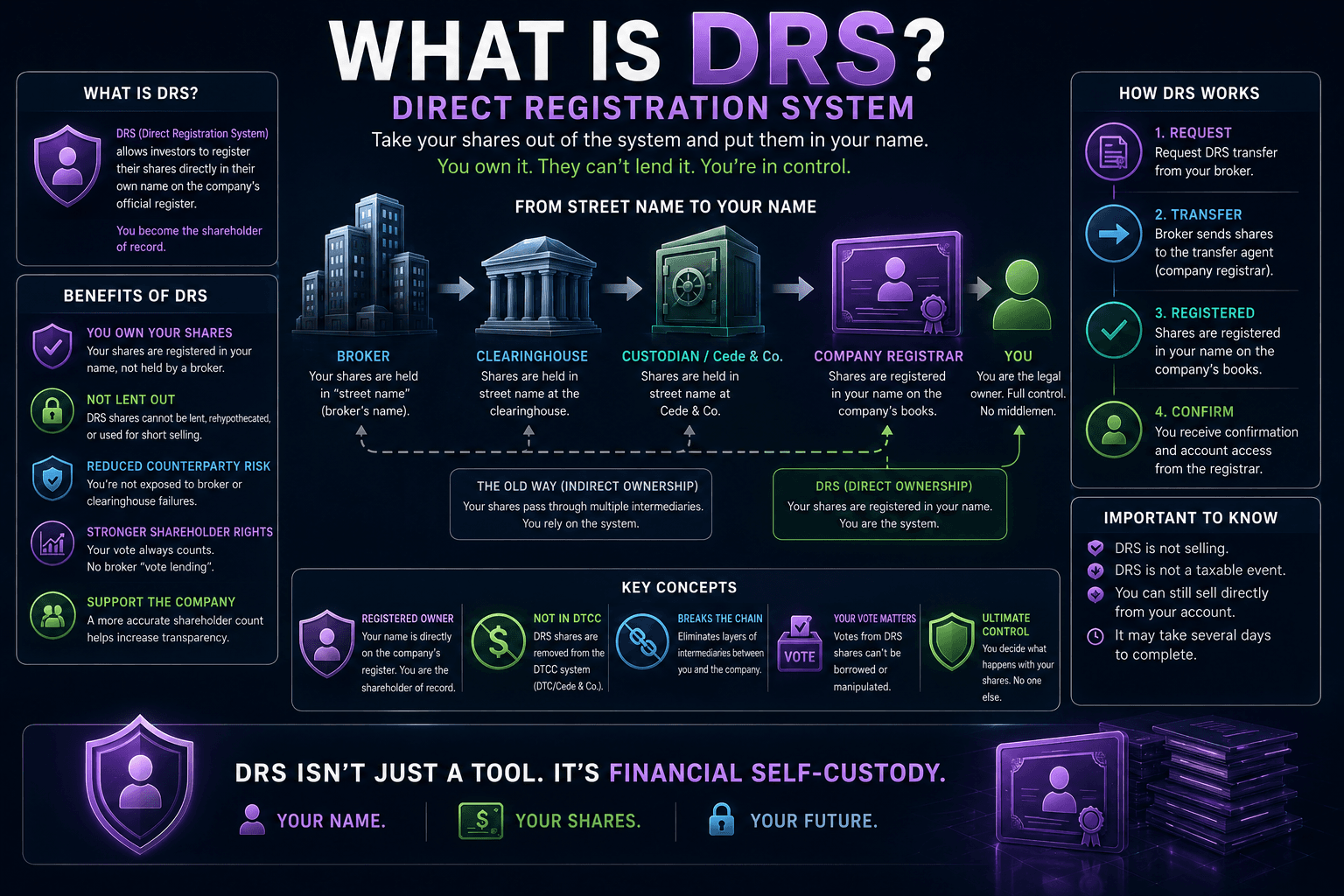
Settlement then occurs through a central securities depository, which holds the master record of who owns what. Crucially, most shares are not registered in individual investors' names at this level; they are held in the name of a depository nominee (in the US, the famous "Cede & Co"), with brokers and their clients recorded further down a chain of intermediaries. This is efficient — it allows electronic settlement at vast scale — but it means the shares you "own" sit several layers away from the company's own register. That layered reality, and the alternative of registering directly, is the subject of the direct-registration (DRS) lesson.
A Word On High-Frequency Trading
No description of modern market structure is complete without high-frequency trading (HFT) — firms using powerful computers and ultra-fast connections to trade in microseconds. Some HFT activity is simply automated market making, tightening spreads and adding liquidity, which benefits ordinary investors. Other strategies are more controversial, profiting from tiny speed advantages in ways critics argue extract value from slower participants. The reality is nuanced: HFT has lowered explicit trading costs for retail investors while raising legitimate questions about fairness and stability. For a long-term investor, its main practical effect is that the market you trade into is faster and more automated than ever — neither a villain to fear nor a friend to celebrate, but a feature of the landscape to understand.
Why It Matters To You
Tying it together: even if you only buy a broad ETF once a month and hold for decades, you depend on this structure every time you transact. The spread you cross is a real cost; the liquidity of what you buy affects how cleanly your order fills; the venue your broker routes to, and any payment it receives for doing so, influences your execution price; and the settlement and custody chain determines the precise nature of what you own. None of this should frighten you away from investing — the system works remarkably well for ordinary investors most of the time — but understanding it lets you choose better brokers, trade liquid instruments, use sensible order types, and see the market clearly rather than mysteriously.
Risks & Considerations
- Liquidity risk. Thinly traded assets have wide spreads and can be hard to exit at a fair price, especially in stress.
- Execution quality varies. Where and how your order is routed affects the price you get, often invisibly.
- Transparency trade-offs. The growth of off-exchange trading can weaken public price discovery.
- Settlement and intermediary risk. The layered custody chain is efficient but means you rely on the soundness of multiple institutions.
- Volatility and structure. In rare events, structural features (such as automated trading halts or liquidity evaporating) can produce sharp, disorderly price moves.
Common Misconceptions
- "The price on my screen is the price everyone gets." Prices vary slightly by venue and moment; the spread and routing mean your fill can differ.
- "Dark pools are illegal or sinister." They are legal, regulated venues that serve a genuine purpose, though they raise real transparency questions.
- "When I buy a share, my name goes on the company's register." Usually not — you sit at the end of a chain of intermediaries.
- "Market structure only matters to traders." It affects every transaction, including those of the most patient long-term investor.
Real-World Application
Suppose you want to buy a small, rarely traded company rather than a large, liquid one. Understanding market structure changes how you act: you check the spread (likely wide), you see thin depth in the order book, and you use a limit order rather than a market order so you are not filled at a poor price by the scarce liquidity available. Contrast that with buying a giant, heavily traded ETF, where the spread is a penny and depth is enormous — a market order fills instantly at a fair price. Same investor, same broker, but knowledge of the underlying structure leads to a smarter decision and a better price. That is market structure working for you, once you can see it.
Key Takeaways
- Market structure is the machinery — venues, participants and rules — that turns an order into a settled trade.
- A trade passes through routing, matching, execution, clearing and settlement, with execution and settlement being separate events (typically T+1).
- The order book sets prices through supply and demand; the bid-ask spread is an implicit cost and liquidity measures how easily you can trade.
- Market makers supply liquidity for the spread; lit venues show orders publicly while dark pools hide them to reduce market impact.
- Most shares are held through a layered custody and settlement chain, not registered in your own name — the basis for the DRS discussion.
- Market structure affects the price, speed and cost of every trade, so it matters even to long-term investors.
Finished this lesson? Track your progress.
Frequently asked questions
What is market structure and why does it matter to investors?
Market structure is the system of venues, participants, and rules that determines how trades actually happen — turning an order into a completed, settled transaction. It matters because it directly affects concrete outcomes: the spread you pay, execution quality, the price you receive, and who profits from handling your order; over a lifetime of investing, these structural details compound just like returns and fees do.
How does a trade move from placing an order to final settlement?
A trade passes through five stages: your order is placed via a broker, routed to a trading venue, matched and executed with a counterparty, cleared (confirmed by a clearing house), and then settled one business day later (T+1), at which point ownership is recorded in a central depository.
What are the main players in the market ecosystem?
The key players are: investors (individuals and institutions wanting to buy or sell), brokers (intermediaries that route orders), exchanges and trading venues (marketplaces where orders meet), market makers (firms that provide liquidity by continuously quoting prices), and clearing houses and depositories (back-office institutions that confirm trades and keep ownership records).
How did markets evolve from a single trading floor to today's fragmented system?
Markets transformed through two waves: electronification in the late twentieth century replaced human floor traders with computer matching engines (reducing execution time from minutes to microseconds), and then regulation deliberately broke exchange monopolies, encouraging competition from new venues and dark pools, creating today's fragmented market where a single stock trades simultaneously across multiple venues.
What is the difference between lit venues and dark pools?
The article mentions that market structure includes both public 'lit' venues and private 'dark' ones as part of the fragmented market landscape, but does not provide detailed comparison of their differences in the provided content.
Key terms
Next lesson
Continue learning
What Is Payment For Order Flow?
Related topics
Ironclad Research provides educational content only. Nothing on this platform is financial advice, a recommendation, or an offer to buy or sell any security. Always do your own research and consider professional advice before making financial decisions.