Naked Short Selling
Ordinary short selling borrows shares before selling them. Naked short selling skips that step — selling shares that were never borrowed or arranged for. It is tightly regulated in the US, it is one way 'fails to deliver' can arise, and it sits at the centre of one of the most heated debates in modern markets. Learn what it is, what Regulation SHO actually requires, the market-maker exemption, and how to read the controversy without the myths.
Written by James Lipyeat · Founder, Ironclad Research
Reviewed 23 July 2026 · Editorial policy
Before this, read
Introduction
The short selling lesson described the normal process: borrow shares, sell them, buy them back, return them. Naked short selling is what happens when the first step is skipped — selling shares short without having borrowed or arranged to borrow them for delivery. That distinction sounds technical, but it matters enormously: it bears on whether a real share is delivered to the buyer, and it sits at the heart of one of the most contested arguments in modern markets.
This is an advanced, and genuinely controversial, topic. The aim here is to explain it accurately and neutrally — what naked shorting actually is, what the rules require, why "fails to deliver" happen, and how to think about the debate without either swallowing the myths or waving away the real mechanics. Nothing here is a claim about any specific stock, and nothing here is investment advice.
Quick Definition
Naked short selling generally means selling shares short without having borrowed or arranged to borrow the shares needed to deliver them. In the US, Regulation SHO separately requires the broker to obtain a valid "locate" — reasonable grounds to believe the shares can be borrowed in time — before most short sales.
Three things are worth keeping distinct, because they're often blurred together: the locate (sourcing the shares), the borrow (actually securing them), and the delivery at settlement. A short sale without a completed borrow does not automatically fail — the seller can still borrow or buy the shares before settlement and deliver on time. But if the shares aren't secured by then, delivery can slip, and that is a fail to deliver.
What Regulation SHO Requires
In the US, short selling is governed by the SEC's Regulation SHO (2005). Its rules are what turn abusive naked shorting into a violation — but note they govern three distinct things (sourcing, delivery, and conduct), not one:
- The locate requirement. Before most short sales, the broker must have borrowed the shares, arranged to borrow them, or have reasonable grounds to believe they can be borrowed in time to deliver. Failing this can be a Reg SHO violation — but a locate is about sourcing the shares, and having one does not by itself guarantee delivery.
- The close-out requirement (Rule 204). Fails to deliver must be closed out within set deadlines — generally by buying or, in some cases, borrowing shares of like kind and quantity. This applies broadly to fails in equity securities, not only to a special list.
- Threshold securities (Rule 203). Separately, stocks with large, persistent aggregate fails — broadly, at least 10,000 shares and 0.5% of shares outstanding for five straight settlement days — land on a "threshold securities" list, which carries extra close-out requirements for certain fails that stay open (for those, after 13 consecutive settlement days).
- The alternative uptick rule. A separate circuit-breaker restricting short selling in a stock after it falls 10% in a day — aimed at preventing shorts from piling onto a decline.
In 2008 the SEC eliminated the special options market-maker exception from the threshold-security close-out requirement — not the separate bona-fide market-making locate exception, which remains — and adopted Rule 10b-21, which targets sellers who deceive a broker or buyer about their intention or ability to deliver and then fail to deliver. So the accurate position is narrower than "naked shorting is banned": naked short selling is not automatically a violation in every circumstance, but conduct involving defective locates, unresolved fails, deception, or manipulation can break the rules.
Fails To Deliver — And Their Many Causes
A fail to deliver (FTD) occurs when the seller doesn't deliver the shares to the buyer by the settlement date (T+1 in the US since 2024). Naked short selling is one cause — if you sold shares you never had, you may not be able to deliver them. But it is not the only cause, and this is the single most important nuance in the whole topic:
- A long seller may fail to deliver because their own shares were delayed arriving.
- Operational and processing errors cause routine, short-lived fails.
- Bona fide market-making can create brief, legitimate fails while liquidity is provided.
The SEC publishes FTD data, which anyone can examine — but it must be read carefully. The figures are aggregate settlement positions at the clearing level, not a daily tally of new naked short sales, and they don't identify who caused a fail. So they can't be summed day-by-day as though each entry were fresh and unresolved (a common error), and their size only means something relative to a stock's shares outstanding, trading volume and how long the fails persist. Regulators treat large, persistent fails as a red flag worth investigating and require them to be closed out. But a fail, by itself, is not proof of manipulation — it is a signal to look closer, not a verdict. Reading it as automatic evidence of wrongdoing is the most common analytical error in this area.
The Market-Maker Exemption
One legitimate wrinkle is worth understanding. Bona fide market makers — firms that continuously quote both a buy and a sell price to provide liquidity — sometimes need to sell short to fill a customer's buy order in the instant before they've arranged a borrow. Because this is a genuine market function, they have a narrow exemption from the locate requirement for real market-making activity.
This is frequently misunderstood as "market makers are allowed to naked short freely." They are not. The exemption is narrow, applies only to genuine liquidity provision (not directional bets), and does not remove the delivery obligation: qualifying bona-fide market-making fails get a longer close-out deadline under Rule 204, but must still be closed out within it. The broader, more abusable options market-maker exception (to the threshold-security close-out rule) was eliminated in 2008 precisely because it was being misused.
The Controversy, Fairly Stated
Naked short selling became a mainstream argument during the meme-stock era, when some retail investors argued that widespread, hidden naked shorting was creating "phantom" or "synthetic" shares — selling more shares than exist to suppress prices. It is worth stating the two poles honestly, because both contain truth and both are often overstated:
- The concern is not baseless. Naked shorting is a real mechanism, fails do happen, the data is imperfectly transparent, and history has genuine cases of abusive naked shorting that regulators prosecuted. Wanting more transparency and tighter enforcement is a reasonable position.
- The strong claims are unproven. The leap from "fails exist" to "billions of phantom shares are secretly suppressing this specific stock" is not established by the public data, which has multiple innocent explanations and whose size and significance vary a great deal by stock and period — it has to be weighed against a security's shares outstanding, trading volume and how long fails persist, not read in isolation. Regulators maintain that abusive naked shorting is illegal, pursued, and not the market-wide force some believe.
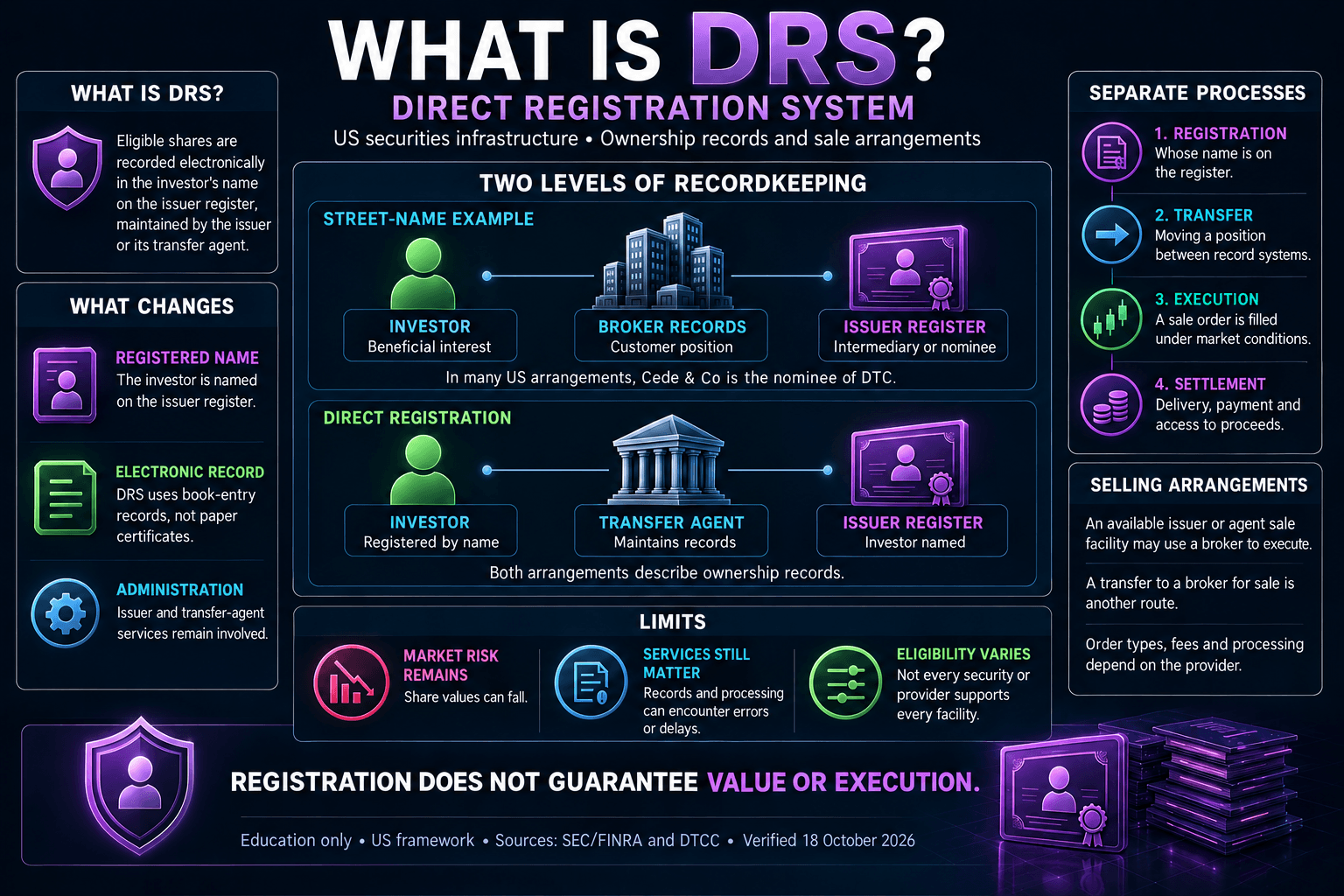
The honest middle is this: naked short selling is a real and heavily-regulated practice — with locate, delivery and conduct rules that abusive behaviour can break; fails to deliver are public but ambiguous; and while the existence of abusive cases is established, how prevalent undetected abuse is — and how much it moves prices — remains disputed, and public FTD data alone can't settle it. This is also part of why direct registration (DRS) entered the conversation: registering shares in your own name with the transfer agent, rather than holding them in a broker's account, stops that broker from lending those particular shares — though it doesn't remove other investors' shares from the lending market, or by itself prove or prevent naked shorting elsewhere. (See DRS.)
Common Misconceptions
- "Every fail to deliver is illegal naked shorting." No — fails have several legitimate causes. FTDs flag something to investigate, not a proven crime.
- "Naked short selling is legal and common." Abusive naked shorting is prohibited; the only carve-out is a narrow bona-fide market-maker function, still subject to close-out.
- "Market makers can print unlimited shares." They can briefly sell short to provide liquidity, but they must close out fails; they are not exempt from delivery.
- "Short interest above 100% of float proves naked shorting." Not necessarily — the same shares can be borrowed and re-lent along a chain, so reported short interest can legitimately exceed the float without any naked shorting. (See reading short-selling data.)
Real-World Application
An investor studying a heavily-shorted stock finds its name on the SEC's fails-to-deliver data and sees online claims that this "proves" massive naked shorting. Rather than accept or dismiss it, they apply what they now understand: fails have several causes; the figures should be judged against the stock's trading volume and share count, not in isolation; the close-out rules mean sustained fails are supposed to be resolved; and reported short interest exceeding the float can arise from legitimate re-lending. They conclude that the data is worth watching and raises fair questions about transparency, but does not, on its own, prove a hidden conspiracy — and they don't make a trade on the strength of a claim the evidence can't support. That disciplined, mechanism-first reading — neither credulous nor dismissive — is the whole value of understanding naked short selling properly.
Key Takeaways
- Naked short selling = selling shares short without having borrowed or arranged to borrow them — so they may not be delivered on time. Keep the locate (sourcing), the borrow (securing) and delivery distinct.
- Regulation SHO governs three things: a locate before shorting; close-out of fails under Rule 204 (broadly, across equity securities, by buying or borrowing); and a separate threshold-securities regime (Rule 203) for large, persistent fails. The alternative uptick rule restricts shorting after a 10% daily fall. A 2008 change removed the options market-maker exception from the threshold close-out rule and added antifraud Rule 10b-21.
- Naked shorting is not automatically illegal; the violations are defective locates, unresolved fails, deception (10b-21), or manipulation.
- Fails to deliver (FTDs) are public but ambiguous — naked shorting is one cause among several (operational delays, long-sale fails, bona-fide market making). They're aggregate positions, not daily new-short tallies, and a fail is a flag to investigate, not proof of manipulation.
- That abusive cases exist is established; how prevalent they are, and how much they move prices, remains disputed and can't be inferred from FTD data alone. Read it mechanism-first, neither credulous nor dismissive — and note why DRS enters the conversation.
Finished this lesson? Track your progress.
Frequently asked questions
What is naked short selling in simple terms?
Naked short selling generally means selling shares short without having borrowed or arranged to borrow the shares needed to deliver them. Ordinary short selling secures the shares first; naked shorting skips that step. In the US it is tightly governed by Regulation SHO (which requires a locate and the close-out of fails), and it is one way that "fails to deliver" can arise, where the buyer doesn't receive their shares on time.
Is naked short selling illegal?
Naked short selling is not automatically illegal in every circumstance — the SEC itself says so. What is prohibited is the abusive conduct around it: violating the locate requirement, failing to comply with the close-out rules, deceptive conduct under the 2008 antifraud rule (10b-21), or manipulation under broader securities law. A narrow exemption exists for bona fide market makers providing genuine liquidity, but it does not permit abusive naked shorting, and they must still close out fails (within a longer deadline).
What are fails to deliver, and do they prove manipulation?
A fail to deliver happens when the seller doesn't deliver shares to the buyer by the settlement date. Naked short selling can cause fails, but so can ordinary operational delays and long sales where delivery slips. Regulators treat large, persistent fails as a red flag worth investigating and require them to be closed out — but a fail on its own is not proof of manipulation, which is why the data is a starting point for scrutiny rather than a verdict.
What is Regulation SHO?
Regulation SHO is the SEC's 2005 framework governing short sales. Its core parts are the locate requirement (source borrowable shares before shorting), the Rule 204 close-out requirement (resolve fails to deliver in equity securities within set deadlines, by buying or borrowing) — which applies broadly, not only to a list — a separate "threshold securities" regime for stocks with large, persistent fails, and the alternative uptick rule that restricts short selling in a stock that has fallen 10% in a day. It was tightened in 2008, including removing the options market-maker exception from the threshold close-out rule and adding antifraud Rule 10b-21.
Key terms
Next lesson
Continue learning
Reading Short-Selling Data: Short Interest, Short Volume & Cost to Borrow
Related topics
Ironclad Research provides educational content only. Nothing on this platform is financial advice, a recommendation, or an offer to buy or sell any security. Always do your own research and consider professional advice before making financial decisions.