Short Selling
How do you profit when a stock falls? You borrow it, sell it, and buy it back cheaper. Short selling is one of the market's most powerful — and most dangerous — mechanics: theoretically unlimited losses, a borrow fee, dividends you owe, and the ever-present risk of a short squeeze. Learn exactly how it works, where the borrowed shares come from, and why the risk is shaped so differently from going long.
Written by James Lipyeat · Founder, Ironclad Research
Reviewed 23 July 2026 · Editorial policy
Before this, read
Introduction
Almost everything a beginner learns about markets assumes you buy first and sell later — you own something and hope it rises. Short selling turns that on its head. It is how a trader profits when a price falls, and it powers everything from hedge-fund bets to the dramatic short squeezes that made headlines in the meme-stock era.
It is also genuinely dangerous, in a way going long is not — and understanding exactly why is the point of this lesson. Short selling has a risk profile shaped like nothing else in investing: a small, capped potential gain against a theoretically unlimited potential loss. This lesson walks through the mechanics step by step, shows where the borrowed shares actually come from, tallies the real costs, and explains the squeeze. It builds on what a stock is and margin accounts.
Quick Definition
Short selling is borrowing shares, selling them at today's price, and buying them back later to return to the lender. You profit if the price falls between selling and buying back — and you lose if it rises.
You are, in effect, selling something you don't own, with a promise to replace it. The whole trade is a bet on decline.
How It Works, Step By Step
Picture shorting 100 shares of a stock trading at $50.
- Borrow. Your broker locates 100 shares to lend you (more on where they come from below).
- Sell. You sell the borrowed shares immediately at $50, receiving $5,000. This cash isn't really yours to spend — you owe 100 shares back.
- Wait. You are now "short 100 shares." You want the price to fall.
- Buy back (cover). Say the stock drops to $40. You buy 100 shares for $4,000 and return them to the lender.
- Keep the difference. You received $5,000 and spent $4,000 — a $1,000 profit, minus costs.
If instead the stock had risen to $65, you'd have to buy back at $6,500 — a $1,500 loss. Same position, opposite outcome. The trade is simply a long position run backwards: sell high first, buy low later, and hope the order works out.
Where The Borrowed Shares Come From
A short sale is impossible without shares to borrow, and understanding that supply chain explains much of short selling's behaviour. The shares come from the securities-lending market:
- Margin accounts. When you hold shares in a margin account, your broker can lend them out to short sellers — a practice called rehypothecation. Most retail investors are unaware their shares are working this way.
- Institutional lenders. Index funds and pension funds hold huge, stable share piles and lend them out to earn extra income.
The lender earns the borrow fee, and the short seller must return equivalent shares later. This is why a stock with few available shares to borrow is "hard to borrow" — and why, when borrowing dries up, shorting becomes expensive or impossible.
The Real Costs Of Being Short
Shorting is not free money on the way down. A short seller pays:
- The cost to borrow (CTB). An annualised fee to the lender, set by supply and demand. Pennies for a widely-held stock; it can run to double-digit or even triple-digit percentages a year for a scarce, heavily-shorted one — a serious drag on any short.
- Dividends. If the stock pays a dividend while you're short, you owe it. The buyer of the shares you sold receives the real dividend, so you must reimburse the lender to make them whole.
- Margin. Short selling requires a margin account and collateral; the position is marked to market daily, and a rising price can trigger a margin call.
These carrying costs mean a short can be right about the direction and still lose money if the decline takes too long.
Why The Risk Is Shaped So Differently
This is the heart of short selling. When you buy a stock, your loss is capped: the price can only fall to zero, so you can lose 100% and no more. When you short, there is no ceiling — the price can rise 200%, 1,000%, more — and you must eventually buy it back at whatever it costs. Your loss is theoretically unlimited.
This asymmetry compounds a nasty feedback: as a short position moves against you, it grows larger as a share of your account (the rising stock is a bigger liability), so your risk increases exactly when you're losing — the opposite of a long position, which shrinks as it falls.
The Short Squeeze
That feedback is the engine of the short squeeze. When a heavily-shorted stock starts rising, short sellers face mounting losses and margin pressure, and rush to cover — buying shares to close out. But that buying is itself demand, which pushes the price higher, forcing more shorts to cover, and so on. A crowded short can turn into a violent upward spike detached from any change in the underlying business. This is what happened in the most dramatic meme-stock episodes, and it is why a high level of short interest can be a double-edged sword: bearish sentiment, but also stored-up forced buying if the stock turns. (The metrics that measure this are covered in reading short-selling data.)
The Rules
Short selling is legal and serves real functions — it adds liquidity, aids price discovery, and lets investors hedge or express negative views. But it is regulated. In the US, Regulation SHO requires a short seller to locate borrowable shares before selling (you must have borrowed, arranged to borrow, or have reasonable grounds to believe you can borrow them), and an "alternative uptick rule" restricts shorting a stock after it has fallen 10% in a day, to prevent piling on during a decline. Selling short without having borrowed or arranged to borrow the shares — skipping that step — is naked short selling, covered in its own lesson.
Common Misconceptions
- "Short selling is just betting, and it's bad for the market." It has real economic functions — hedging, liquidity, and exposing overvalued or fraudulent companies (many frauds are first flagged by short sellers). It is also, done carelessly, a fast way to ruin.
- "You can hold a losing short forever, like a long." No. Borrow fees accrue, dividends are owed, margin is marked daily, and the lender can recall the shares — forcing a buy-in at a bad moment. Time is against a short in a way it isn't against a patient long.
- "A short seller's loss is capped like a long's." The reverse — the loss is uncapped. This single fact should govern how any short is sized.
- "Short interest going up means the price will fall." Not necessarily — heavy short interest is also fuel for a squeeze upward. It measures positioning, not destiny.
Real-World Application
A trader is convinced a richly-valued company will disappoint at earnings. Rather than buy a put option, they short 100 shares at $80, receiving $8,000. They know the trade's shape cold: their best case is the stock going to zero (an $8,000 gain), while their worst case is unbounded — so they size it small, set a hard stop above the entry, and note the borrow fee is a manageable 2% a year. Earnings miss, the stock falls to $60, and they cover for a $2,000 profit. Had it instead gapped up on a surprise buyout bid, their stop would have forced them out fast — because they understood from the start that a short left to run against you has no natural floor to your loss. They treated the position not as "a long in reverse" but as the fundamentally more dangerous instrument it is, and sized it accordingly. That respect for the asymmetry — not the direction of the bet — is what separates a disciplined short from a blown-up account.
Key Takeaways
- Short selling = borrow shares, sell them, buy them back later to return. You profit if the price falls.
- Borrowed shares come from the securities-lending market — often other customers' margin-account shares (rehypothecation) or institutional lenders — and you pay a cost to borrow, plus any dividends.
- The risk is asymmetric and theoretically unlimited: a long can only lose its stake, but a short's loss has no ceiling because the price can rise without bound — and the position grows against you as it loses.
- Rising prices can trigger a short squeeze: forced covering that feeds on itself into a sharp spike.
- It is legal and useful (hedging, liquidity, price discovery) but tightly governed by Regulation SHO — and demands a margin account and disciplined sizing. Selling short without a locate is naked short selling.
Finished this lesson? Track your progress.
Frequently asked questions
How does short selling actually work, step by step?
A short seller borrows shares (usually through their broker), sells them at the current market price, and waits. If the price falls, they buy the shares back cheaper, return them to the lender, and keep the difference as profit. If the price rises, they must still buy them back — now at a higher price — and take a loss. The whole trade profits from a decline instead of a rise.
Why is short selling considered so risky?
The risk is asymmetric. When you buy a stock, the most you can lose is what you paid, because a price can only fall to zero. When you short, the stock can rise without limit, so your potential loss is theoretically unlimited. On top of that you pay a borrow fee, owe any dividends, and face the risk of a short squeeze or a forced buy-in if the lender recalls the shares.
Where do the borrowed shares come from?
From the securities-lending market. Brokers commonly lend out shares held in customers' margin accounts (a practice called rehypothecation), or borrow from large institutional holders like index funds. The lender earns the borrow fee and the short seller must return equivalent shares later. This is why short selling depends on shares being available to borrow at all.
Can you lose more than you invested when short selling?
Yes. Because a stock's price has no upper limit, the cost to buy back a short position can exceed the amount you received when you sold — meaning the loss can be larger than your original proceeds, and in a severe squeeze, larger than your account. This is why short selling requires a margin account and careful risk management, and why unbounded loss is its defining danger.
Key terms
Next lesson
Continue learning
Naked Short Selling
Related topics
Reading Short-Selling Data: Short Interest, Short Volume & Cost to Borrow
Three numbers get quoted endlessly to judge how heavily a stock is shorted — short interest, short volume, and cost to borrow — and two of them are constantly misread. Learn what each actually measures, why short volume is NOT short interest, why short interest can legitimately exceed 100% of the float, and why the borrow fee is often the most honest real-time signal of the three.
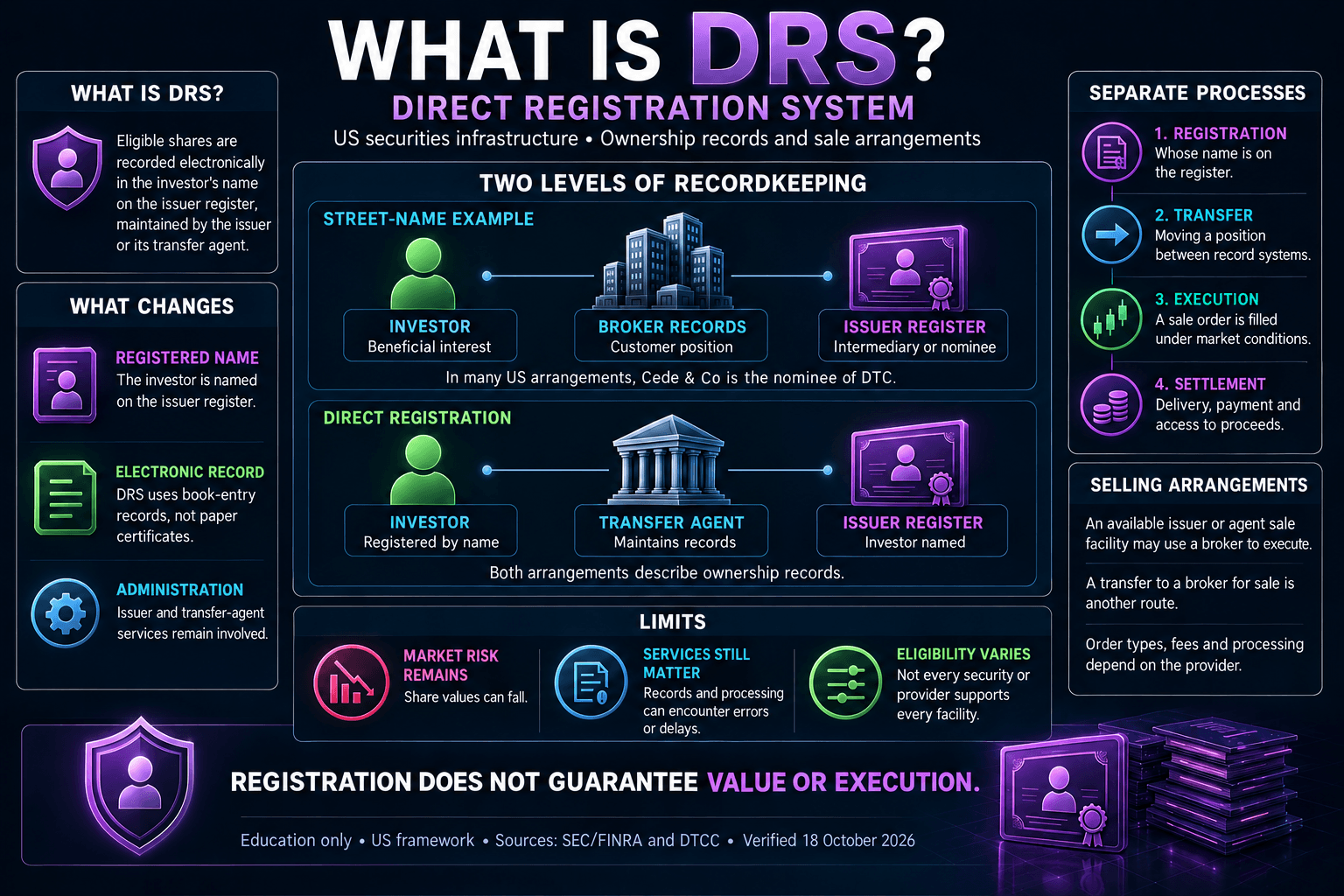
What Is DRS?
A US-focused explanation of the Direct Registration System (DRS), street-name records, transfer agents and sale arrangements, separating ownership mechanics from market risk and provider-specific terms.
Ironclad Research provides educational content only. Nothing on this platform is financial advice, a recommendation, or an offer to buy or sell any security. Always do your own research and consider professional advice before making financial decisions.