Options
Calls, puts, the Greeks, and the strategies built from them.
32 guides12+ key termsTopic quiz available
The options curriculum
Beginner2 guides
Open Interest and Volume
Open interest and volume are the two liquidity gauges printed beside every option. This lesson explains what each measures — volume as the day's trades, open interest as the contracts still outstanding — how they differ, how they signal how easily you can get in and out, their effect on the bid-ask spread, and the common mistake of reading them as a market direction signal.
Strike Price and Expiration
Every option is defined by two coordinates: the strike price (which price) and the expiration date (by when). This lesson explains both, how they appear together on an options chain, the calendar of weekly, monthly and quarterly expirations, long-dated LEAPS, and how the two choices together shape an option's premium and probability of paying off.
Intermediate14 guides
Assignment & Exercise
What actually happens when an option is acted on. Exercise — the holder invoking their right; assignment — the writer obliged to fulfil it; early assignment and why dividends trigger it; physical versus cash settlement; expiry auto-exercise; and pin risk. The plumbing behind every options strategy.
Historical vs Implied Volatility
Volatility comes in two forms: historical (what the underlying actually did) and implied (what the market expects, priced into options). This lesson defines and measures both, explains why implied volatility usually sits above realised — the variance risk premium — and shows how comparing the two tells an options trader whether premium is rich or cheap.
IV Rank and IV Percentile
An implied volatility of 30% is meaningless on its own — high for one stock, low for another. IV Rank and IV Percentile fix that by placing today's implied volatility in the context of its own past year. This lesson defines both, shows how they differ, and explains how traders use them to decide whether to buy or sell option premium.
LEAPS: Long-Dated Options
LEAPS are options with expirations a year or more away — the slow, patient opposite of 0DTE. This lesson covers what they are, how deep in-the-money LEAPS calls are used as a lower-capital, defined-risk stand-in for owning shares, how they power the poor man's covered call, and the trade-offs that come with long-dated options: slow but real decay, meaningful vega and rho, no dividends, and wider spreads.
Moneyness: In, At & Out Of The Money
Where an option's strike sits relative to the share price — in, at or out of the money — and why it governs the intrinsic/extrinsic split, the probability of paying off, the cost, and how the option behaves. The single idea that ties calls, puts and the Greeks together.
Option Premium: Intrinsic & Extrinsic Value
What you actually pay for when you buy an option. The premium split into intrinsic value (real, exercisable worth) and extrinsic value (time and possibility), the four forces that move it, why options decay, and how implied volatility prices uncertainty.
The Cash-Secured Put
The covered call's mirror image: selling a put backed by cash, agreeing to buy a stock you want at a lower price while being paid to wait. How it pays off, the two outcomes, the 'getting paid to set a limit order' framing, and the real risk if the stock collapses.
The Collar
A collar brackets a stock position between a protective put below and a sold call above, defining both the downside and the upside for little or no cost. This lesson builds the collar, shows its bounded payoff, explains the zero-cost collar and how the two strikes trade protection against upside, and when the strategy fits — typically to lock in gains on shares you want to keep.
The Covered Call
The most popular income strategy: selling a call against 100 shares you already own to collect premium. How it pays off, the income-for-upside trade-off, the three outcomes, when it makes sense, and the risks it does — and does not — protect against.
The Option Greeks: An Overview
The Greeks are the dashboard of an option — a set of numbers that measure how its price responds to the things that move it: the underlying, time, volatility and interest rates. This overview introduces delta, gamma, theta, vega and rho together, explains what each answers and how they interact, and points to the deep-dive lessons on each, so you can read a position's risks at a glance.
The Option Greeks: Theta & Time Decay
Theta — the Greek that measures time decay. How much an option loses each day simply because expiration draws nearer, why that decay accelerates into the final weeks, why it peaks at the money, and why it makes time the option buyer's enemy and the seller's ally.
What Is A Call Option?
A focused guide to the call option — the right, but not the obligation, to buy. How a call pays off, its break-even, the leverage that makes it appealing and dangerous, the difference between buying and writing a call, and when it makes sense.
What Is A Put Option?
A focused guide to the put option — the right, but not the obligation, to sell. How a put pays off, its break-even and capped maximum gain, its dual use as a bearish bet and as portfolio insurance, the difference between buying and writing a put, and a full worked example.
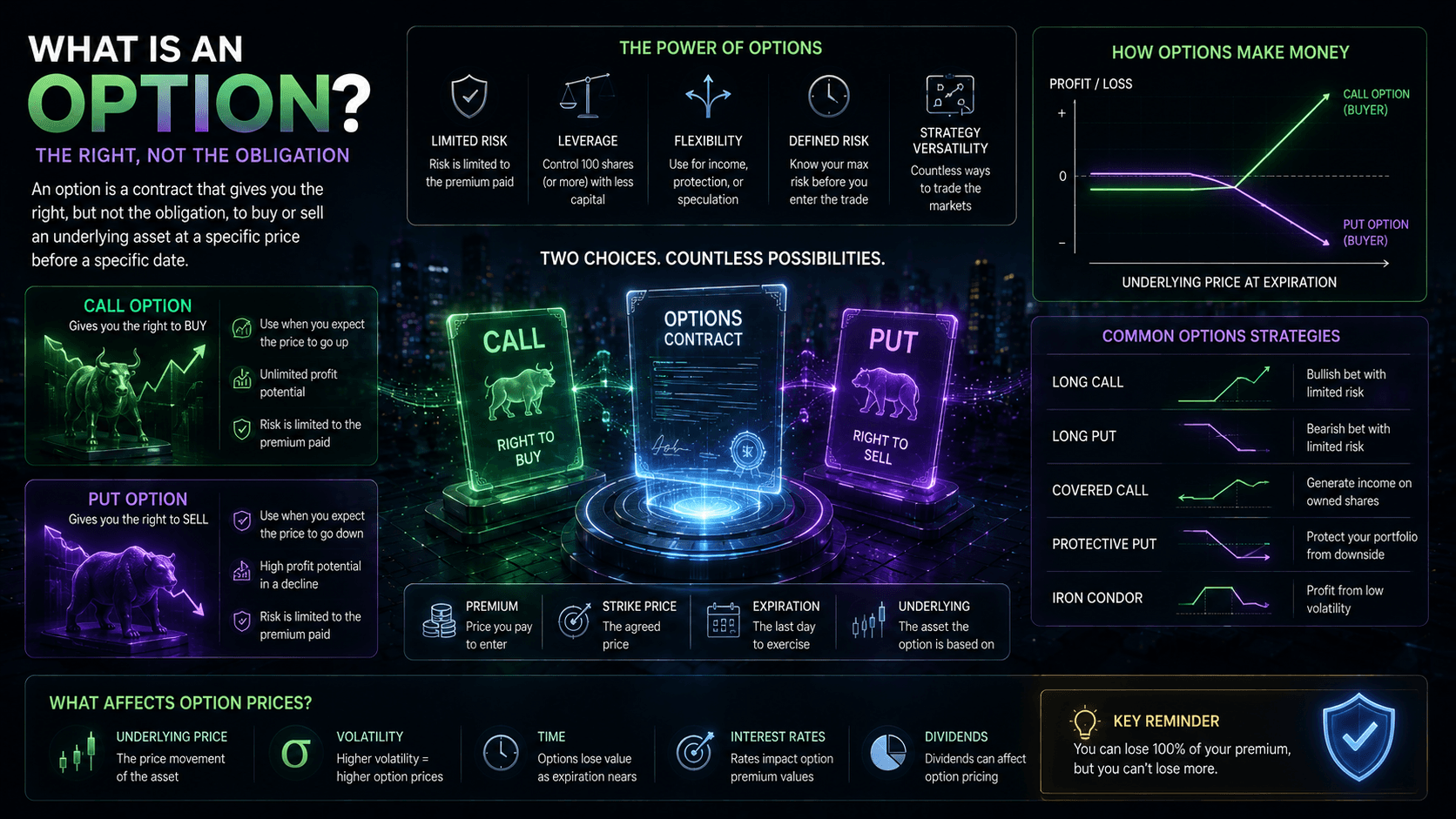
What Is An Option?
A first-principles guide to options: the right but not the obligation, calls and puts, strike and expiration, what drives the premium, the crucial buyer–seller asymmetry, and the real risks of leverage.
Advanced16 guides
0DTE & Short-Dated Options
Zero-days-to-expiration options — contracts that live and die in a single trading session — have grown from a curiosity to roughly half of all S&P 500 index-option volume. This lesson explains what 0DTE, 1DTE and weeklies are, why their gamma and theta behave so violently, the crucial difference between cash-settled index and physically-settled stock options, and the risks that make them a professional's precision tool and a beginner's fast way to lose money.
Calendar Spreads
A calendar spread sells a near-dated option and buys a longer-dated one at the same strike, profiting from the faster decay of the near leg if price sits near the strike. This lesson builds call and put calendars, explains why they are long time-decay and long volatility, shows the curved payoff at the near expiry, covers the diagonal variation, and shows how to rehearse them in the Options Lab.
Credit Spreads
The debit spread's mirror image: sell the nearer option and buy a further one for protection, taking in a net credit. A defined-risk way to profit from time decay and a stock staying away from your strike. Bull put and bear call spreads, the payoff maths, and the probability trade-off.
Long Condors and the Reverse Iron Condor
Two members of the condor family beyond the classic iron condor: the long (call or put) condor, a four-strike range trade with a wider, flatter profit zone than a butterfly; and the reverse iron condor, its inverse, which pays for a breakout in either direction with capped risk. This lesson builds both, contrasts them with the iron condor, and shows how to rehearse them in the Options Lab.
Second-Order Greeks: Vanna, Charm, Vomma & Veta
The first-order Greeks measure how an option reacts to each input. The second-order Greeks measure how those reactions themselves change — how delta drifts as volatility or time moves (vanna and charm), and how vega drifts as volatility or time moves (vomma and veta). These are the cross-sensitivities that dealers hedge and that drive the famous vanna-charm flows around monthly expiration.
Straddles & Strangles
Direction-neutral volatility strategies: buying a call and a put together to profit from a big move either way. The long straddle (same strike) and long strangle (cheaper, wider strikes), their V-shaped payoffs, two break-evens, the volatility-crush trap, and when betting on movement beats betting on direction.
Strips and Straps
The strip and the strap are weighted straddles — volatility trades that still lean in a direction. A strip adds an extra put to profit more from a fall; a strap adds an extra call to profit more from a rise. This lesson builds both, shows the asymmetric V-shaped payoff, contrasts them with the plain straddle, and shows how to rehearse each in the Options Lab.
The Butterfly Spread
The butterfly is a defined-risk, three-strike strategy that profits when the underlying finishes near a chosen central price. This lesson builds the long call and long put butterfly, shows the tent-shaped payoff, then covers the iron butterfly (its credit-based cousin) and the broken-wing butterfly (a skewed version that can be opened for a credit), with worked numbers and how to practise each in the Options Lab.
The Iron Condor
A four-legged, defined-risk, market-neutral strategy: sell an out-of-the-money put spread and an out-of-the-money call spread to collect a credit and profit if the stock stays in a range. The payoff plateau, the high-probability trade-off, and how time decay pays you for stillness.
The Option Greeks: Delta & Gamma
The first two Greeks. Delta — how much an option's price moves per dollar of underlying, its share-equivalent exposure, and its read as a probability. Gamma — how delta itself changes, the accelerator that makes at-the-money options near expiry so explosive.
The Option Greeks: Rho
The forgotten Greek. Rho measures how much an option's price responds to a change in interest rates — small for short-dated contracts, but large enough for LEAPS, and for the market as a whole, to matter. Learn why calls gain and puts lose when rates rise, where rho hides in put-call parity, and when it stops being negligible.
The Option Greeks: Vega & Implied Volatility
Vega — how much an option's price moves when implied volatility changes — and implied volatility itself, the market's forecast of future movement baked into every premium. Why both calls and puts gain when volatility rises, the earnings 'volatility crush', and how to trade volatility rather than just direction.
The Poor Man's Covered Call
The poor man's covered call replaces the 100 shares of a covered call with a deep, long-dated call, cutting the capital required by most while keeping a similar income profile. This lesson builds the strategy, explains why a deep in-the-money LEAPS call stands in for stock, shows the payoff and its risks — decay on the long leg, no dividends, early assignment — and how it relates to the diagonal spread.
Third-Order Greeks: Speed, Zomma, Color & Ultima
The deep end of the Greeks. Third-order Greeks measure how the second-order Greeks change — the rate of change of gamma across price (speed), volatility (zomma) and time (color), and the rate of change of vomma across volatility (ultima). Rarely needed to trade, they are the tools of large-book risk management and model calibration, and they complete the picture of how an option's sensitivities cascade.
Trading Volatility: Long and Short Vega
Options let you bet on volatility itself, not just direction. This lesson explains long-vega positions (net option buyers, who profit when volatility rises or a big move comes) and short-vega positions (net sellers, who profit when markets stay calm), the vega–gamma–theta trade-off that defines each, and which Options Lab strategies sit on each side.
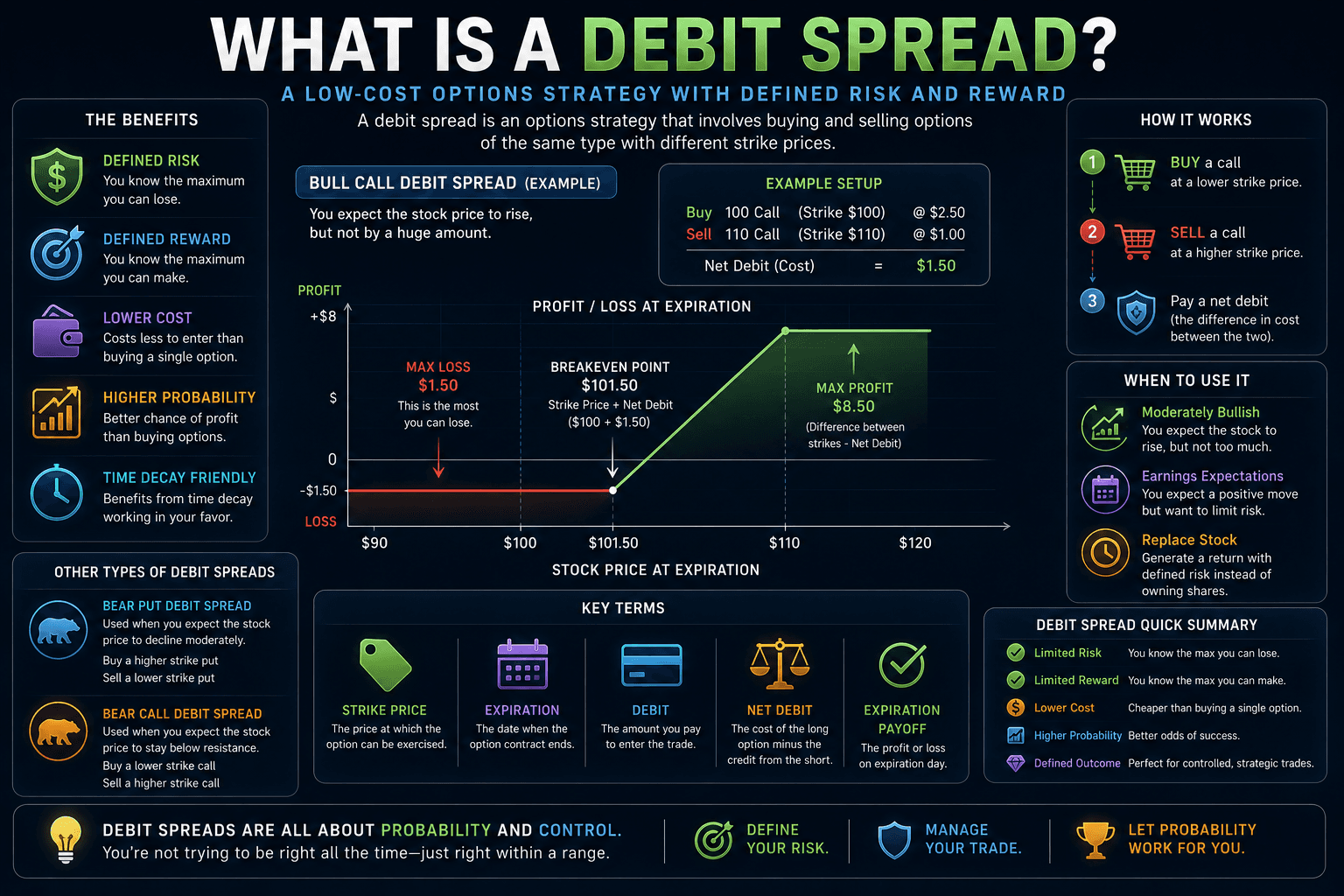
What Is A Debit Spread?
A detailed guide to the debit spread — a defined-risk options strategy that buys one option and sells another to cut cost and cap both loss and gain. Construction, payoff maths, a full worked example, and when to use it.