Cash ISA vs Stocks and Shares ISA
Both are ISAs, both are tax-free — but they do fundamentally different jobs. Learn the real difference between saving and investing, why time horizon is the deciding factor, how inflation quietly erodes cash, how FSCS protection differs, and why the honest answer is often 'both'.
Written by James Lipyeat · Founder, Ironclad Research
Reviewed 23 July 2026 · Editorial policy
Before this, read
Introduction
The two most popular ISAs share a name, an annual allowance and a tax status — and are used for almost opposite purposes. Ask which is "better" and you'll get an unhelpful answer, because they aren't competing for the same job. A Cash ISA is a place to save. A Stocks and Shares ISA is a place to invest. Choosing between them is really about choosing which of those two things you're doing.
This article sets out the real differences, why time horizon settles the question more than anything else, and why the honest answer for most people is "both, for different money".
A note on figures. Allowances, FSCS limits and rules are set by government and regulators and change over time. The structure described here is stable; the numbers are not. Check current figures, and consider professional advice for your circumstances. This is education, not financial advice.
Quick Definition
A Cash ISA holds savings that earn interest, with the balance never falling in nominal terms. A Stocks and Shares ISA holds investments — funds, shares, bonds — whose value rises and falls. Both shelter returns from UK tax; only one can lose money in the short term.
The Real Difference: Saving vs Investing
Everything else follows from this.
Saving means putting money somewhere safe where it earns a modest return. The number on your statement doesn't fall. You know roughly what you'll have.
Investing means buying assets whose value fluctuates, in exchange for a higher expected return over time. The number on your statement absolutely can fall — sometimes sharply, sometimes for years — and the compensation for enduring that is that, historically, over long periods, investments have grown considerably more than cash.
Neither is superior in the abstract. The mistake is using one for the other's job: investing money you need next year, or leaving money you need in thirty years sitting in cash.
Time Horizon Decides It
Money needed soon — a house deposit, a wedding, a car, an emergency fund — belongs in cash. If markets fall 30% two months before you need it, there is no time to recover, and the loss becomes permanent. Certainty is worth more than expected return here.
Money not needed for many years — retirement, a child's future, long-term wealth — has time to ride out downturns, and history suggests equities have substantially outgrown cash over such periods. Here the greater danger is the opposite one.
The Risk People Miss: Inflation
A Cash ISA looks risk-free because the balance never falls. But as covered in Inflation, if your interest rate is below inflation then your money is losing purchasing power every year — quietly, invisibly, and with total reliability.
That's the trade nobody spells out: a Stocks and Shares ISA carries visible, uncomfortable, temporary risk (prices fall and recover). A Cash ISA carries invisible, comfortable, permanent risk (purchasing power erodes and doesn't come back). Over thirty years, the second is usually the larger threat to long-term money — which is why "playing it safe" with a lifetime's savings in cash is not actually the safe choice it feels like.
Protection: What FSCS Does and Doesn't Cover
A common misunderstanding worth clearing up.
- Cash ISA: deposits are protected by the FSCS up to a limit per banking group, if the bank itself fails. Note per banking group — several high-street brands can share one licence, so spreading money across brands doesn't always spread the protection.
- Stocks and Shares ISA: the FSCS covers the failure of the provider or firm (broadly, your assets going missing due to the firm collapsing), up to a limit. It emphatically does not protect you from your investments falling in value.
That distinction is the whole point. Investment risk is not a flaw in the product; it's the thing you're being compensated for taking.
Both Are Tax-Free — So Tax Isn't the Deciding Factor
Both wrappers shelter returns from UK Income Tax and Capital Gains Tax, and both draw on the same annual ISA allowance. So tax treatment doesn't distinguish them in the way people sometimes assume.
There's a subtlety worth knowing, though: a Personal Savings Allowance means many people can earn some bank interest tax-free outside an ISA anyway. When rates are low, a Cash ISA's tax shelter may therefore be doing very little work for a basic-rate taxpayer with modest savings. A Stocks and Shares ISA's shelter, by contrast, tends to become more valuable over time as gains accumulate. (See Stocks and Shares ISA Tax for exactly what is and isn't covered.)
Why the Answer Is Often "Both"
Framing this as a binary choice is the real error. Most sensible financial setups use both, for different money:
- Cash for the emergency fund and anything needed within a few years — so you're never forced to sell investments at a bad moment to cover a boiler replacement.
- Stocks and shares for long-term money that has decades to compound.
Holding a cash buffer is precisely what allows the invested portion to be left alone through a downturn. They support each other rather than compete.
Common Misconceptions
"Cash ISAs are safe and Stocks and Shares ISAs are risky." Both carry risk — just different kinds. Cash risks purchasing power permanently; investments risk value temporarily.
"One is more tax-free than the other." Both shelter income and gains from UK tax. Tax isn't the differentiator; what's inside is.
"I should pick one." They do different jobs. Most people benefit from cash for short-term needs and investments for long-term growth.
"FSCS means I can't lose money in a Stocks and Shares ISA." It protects against firm failure, never against markets falling.
"Investing is gambling." Gambling has a negative expected return by design. Diversified long-term investing has historically had a positive one — the price being volatility along the way.
Real-World Application
Someone has £25,000 and two goals: a house deposit in two years, and retirement in thirty.
Putting the lot in a Cash ISA feels prudent, and protects the deposit — but condemns the retirement money to three decades of inflation erosion, which is close to a guaranteed real loss.
Putting the lot in a Stocks and Shares ISA maximises long-term growth — but risks the deposit falling 20% just as the offer is accepted, with no time to recover.
The sensible structure isn't a compromise between the two; it's using each for what it's good at. The deposit money goes in cash, where certainty is what's needed. The retirement money goes into investments, where time is the ally. Same person, same day, two different answers — because they're two different jobs.
That's the whole lesson: don't ask which ISA is better. Ask what the money is for, and when you'll need it. The answer falls out.
Key Takeaways
- Both are tax-free wrappers; the difference is what's inside — cash earning interest vs investments that rise and fall.
- Time horizon decides: money needed within a few years suits cash; money not needed for 5+ years suits investing.
- Cash carries inflation risk — invisible, permanent erosion of purchasing power — while investments carry visible, temporary volatility.
- FSCS protects deposits (per banking group) and firm failure, but never protects against investments falling in value.
- The answer is usually both: cash for the emergency fund and near-term goals, investments for long-term growth — the buffer is what lets you leave the investments alone.
Finished this lesson? Track your progress.
Key terms
Next lesson
Continue learning
ISA Transfers: Moving Between Cash and Stocks & Shares
Related topics
Stocks and Shares ISA Tax
A Stocks and Shares ISA shelters your investments from Income Tax and Capital Gains Tax — but it doesn't shelter everything. Learn exactly which taxes disappear, the three that still apply (stamp duty, foreign withholding tax and inheritance tax), how the allowance works, and why the shelter matters more the longer you hold.
Risk vs Reward
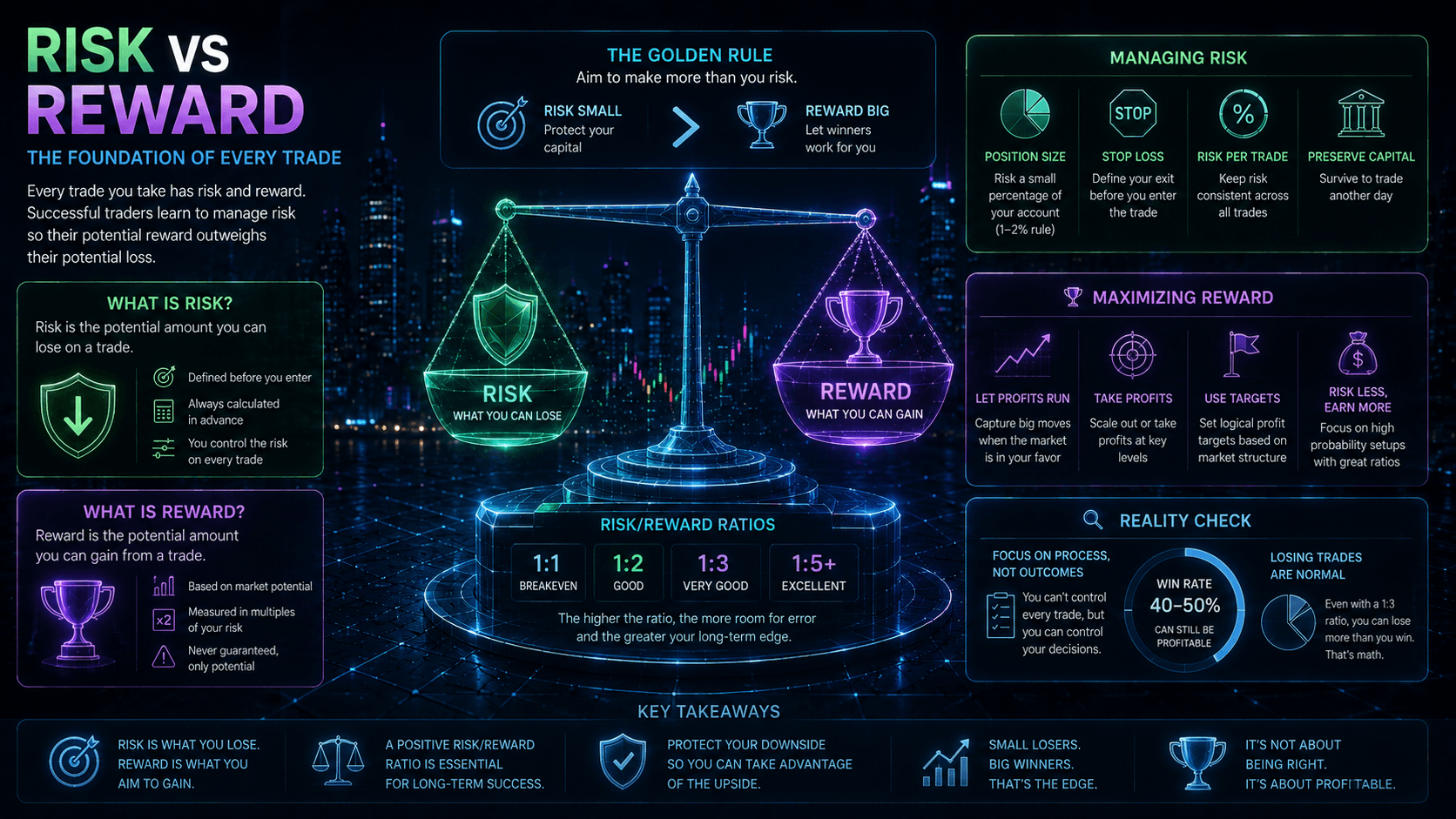
The single most important relationship in finance: why higher potential reward almost always comes with higher risk, how each is measured, the asymmetry of losses, and how to think about the trade-off sensibly.
Ironclad Research provides educational content only. Nothing on this platform is financial advice, a recommendation, or an offer to buy or sell any security. Always do your own research and consider professional advice before making financial decisions.