ETFs & Index Funds
Diversified, low-cost funds that track baskets of assets.
11 guides12+ key termsTopic quiz available
The etfs & index funds curriculum
Beginner4 guides
ETFs vs Mutual Funds
Two ways to own a fund — and the practical differences that matter. How ETFs and mutual funds (including UK OEICs/unit trusts) differ in trading, pricing, minimums, tax efficiency, costs and transparency, and how to choose between them for your situation.
Expense Ratios & Fund Costs
The fee is the one thing you can control, and over decades it is enormous. What the expense ratio (OCF/TER) is, the brutal arithmetic of how a 1% fee compounds against you over 30 years, the hidden costs beyond the headline figure, and how to compare funds on what really matters.
Index Funds & Passive Investing
Arguably the most important idea in investing for ordinary people: owning the whole market cheaply instead of trying to beat it. What an index is, how index funds replicate it, why passive investing beats most active management after costs, and how regular investing turns it into a wealth-building habit.
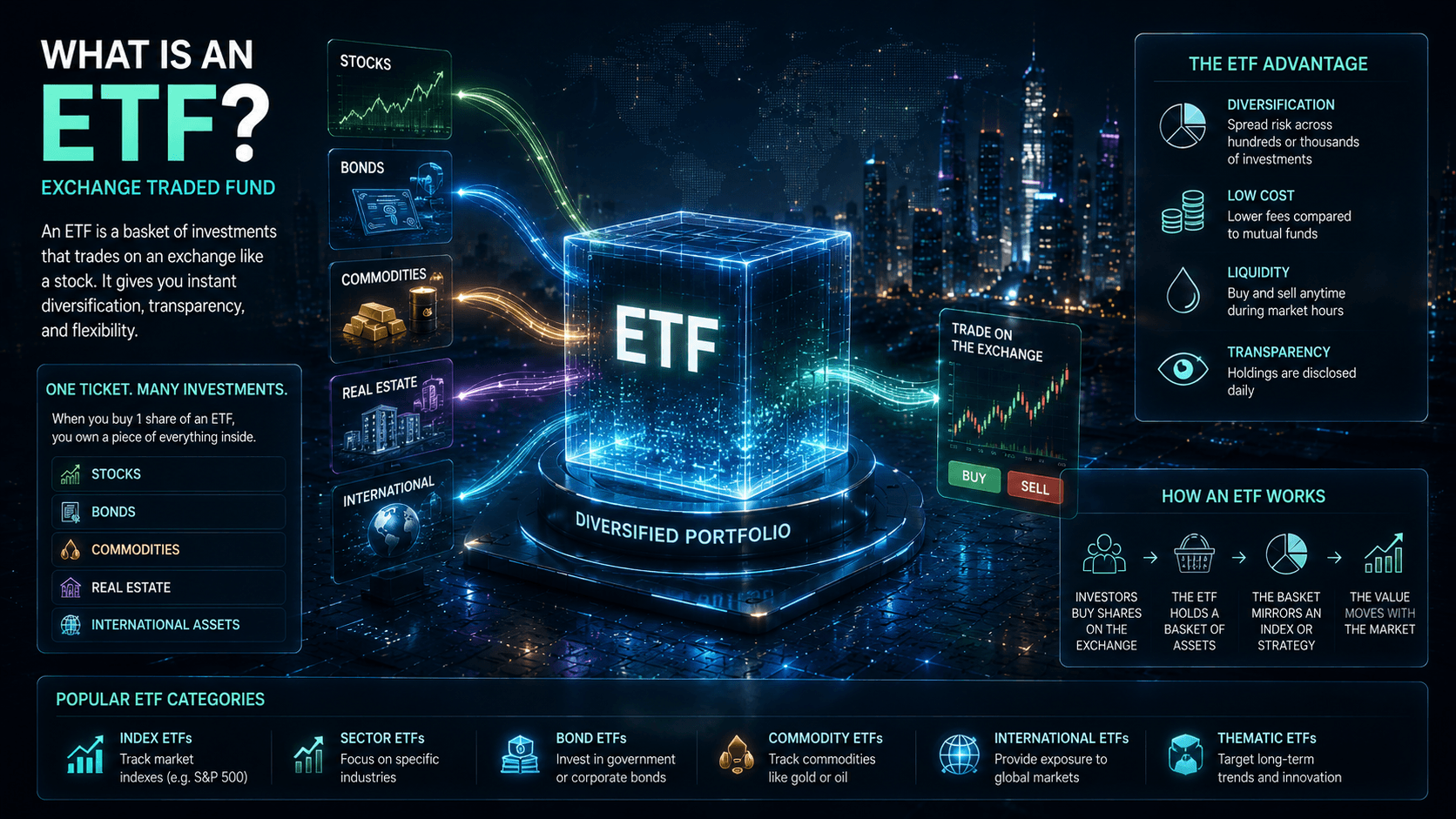
What Is An ETF?
A complete guide to exchange-traded funds: what they are, how they deliver instant diversification, how they track an index, why low costs matter so much, the main types, and the risks.
Intermediate5 guides
Bond ETFs: Income, Duration and Market Prices
Separate a bond ETF share from its underlying bonds, then work through rate sensitivity, credit risk, distributions and the difference between market price and NAV.
IWM: Small-Cap Exposure and Index Reconstitution
Use IWM to study small-cap benchmark boundaries, changing constituents and fund tracking, with worked examples of weighted losses, turnover and transaction prices.
QQQ: Nasdaq-100 Eligibility, Weighting and Overlap
Read QQQ through its benchmark rules, current fund structure and underlying exposures, then calculate weighted contributions and overlap without treating a ticker as a forecast.
Sector ETFs: Classification, Concentration and Overlap
Look through sector ETF labels to understand the underlying businesses, weighting rules, overlapping holdings and sources of concentrated risk.
SPY: The S&P 500, the Fund and the Traded Share
Use SPY as a US-listed ETF case study to separate benchmark rules, fund ownership and exchange prices, with worked examples of weighting, costs and total return.
Advanced2 guides
Inverse ETFs: Negative Exposure, Daily Targets and Hedge Limits
Separate a daily inverse fund from a fixed short sale, calculate negative-target compounding and examine why a simple offset need not remain matched over time.
Leveraged ETFs: Daily Targets and Multi-Day Compounding
Calculate how a daily leveraged target compounds across different paths, why exposure resets, and where a simple model stops describing a real fund.