Securities Lending
Follow a securities loan from delivery through collateral adjustments to return, with worked examples of fees, margin and recall risk.
Written by James Lipyeat · Founder, Ironclad Research
Reviewed 9 October 2026 · Editorial policy
Before this, read
A loan of securities creates a return obligation
Securities lending is an arrangement in which securities are transferred to a borrower with an obligation to return equivalent securities under agreed terms. Collateral and compensation commonly accompany the loan. The security, its quantity, the return obligation, the collateral and the fee are separate parts of the transaction; understanding one does not explain all the others.
This lesson teaches general mechanics across markets, using fictional dollar amounts. It does not set country-specific tax treatment, customer consent requirements, voting rights, investor-compensation protection or legal remedies. Those depend on the jurisdiction, instrument and agreement. Source material was checked on 9 October 2026; historical publications below support mechanics, not claims about current market size or current legal requirements.
Start with clearing and settlement and short selling. For a labelled US ownership-record example, Cede & Co is optional background. By the end, you should be able to calculate a collateral adjustment, distinguish a recall from completed return, and explain why fee income does not eliminate risk. All examples are educational and are not recommendations to lend, borrow or trade.
Why borrow something that can be bought?
An institution may need a particular security temporarily rather than wanting continuing investment exposure to it. The ECB's introductory explanation gives examples involving market making, settlement and other trading or hedging activities. Borrowing can connect an available holding with a temporary delivery need. This general mechanism is separate from the ECB's own policy operations, which are outside this lesson. Source: ECB, What is securities lending?, 8 December 2016; verified 9 October 2026.
Imagine a fictional intermediary that needs to deliver 500 shares into a transaction, while its expected incoming delivery is delayed. Borrowing those shares could help it meet the first obligation, but it creates another obligation to return equivalent shares later. It has changed the timing problem, not made the obligation disappear.
Alternatively, a short seller may borrow securities to deliver after a sale, intending to obtain equivalent securities later. The borrow and the sale are separate transactions. A completed loan does not establish whether the short sale will be profitable, and the lender's fee is not simply the borrower's trading profit passed across.
These examples show why a loan cannot automatically be labelled a directional opinion. The same borrowed security could support different activities. Knowing that borrowing occurred does not reveal the borrower's entire portfolio or the reason for every transaction. The short-selling data lesson explains why borrowing measures need careful interpretation.
Identify the parties and what each owes
The lender supplies the securities. The borrower owes their return and the agreed compensation. An agent may arrange and administer lending for an owner; a custodian or collateral manager may hold assets or process movements. These roles should be distinguished from a guarantee. A firm handling an instruction is not necessarily promising to absorb every loss if something goes wrong.
The joint CPSS/IOSCO report hosted by the BIS describes securities lending as an exchange with a later obligation to redeliver like securities, and separates transaction structures, intermediaries and risks. Its 1999 analysis is used here for the basic structure, not for today's laws or market statistics. Source: BIS, Securities lending transactions: market development and implications, July 1999; verified 9 October 2026.
“Equivalent securities” matters. A loan of 1,000 shares of the agreed class is not ordinarily satisfied by returning 1,000 shares in an unrelated company. Nor should a learner assume that handing back the original dollar value necessarily settles the obligation. The agreement defines delivery and any exceptional close-out process.
In a fungible-security model, the borrower need not return uniquely identifiable paper certificates that travelled out at inception. The obligation is expressed in equivalent securities. Corporate events can change what equivalence requires, so the contract's adjustment provisions matter; the simple calculations below assume no split, merger or other event during the loan.
Collateral is protection, not sale proceeds or income
Collateral supports the borrower's obligation. It may take the form of cash or other eligible assets, with its handling specified by the agreement. A lender receiving collateral has not simply earned that entire amount. Normal completion involves returning or releasing the collateral as the relevant obligations are discharged.
For a learner, keeping three values separate prevents many mistakes: the current value of securities on loan, the value assigned to collateral, and the compensation earned over time. Their units can all be dollars while their meanings differ. A $50,000 loan supported by $52,500 collateral does not generate $2,500 of lending income at inception.
The amount of extra collateral and the valuation convention are contractual and market-dependent. The International Securities Lending Association's institutional guide discusses collateral valuation, margin and lending compensation. It provides useful industry context, but its historical market percentages are not used as current facts here. Source: ISLA, Institutional Investor Guide to Securities Lending, April 2021 file; verified 9 October 2026.
Also distinguish overcollateralisation from a haircut definition. A requirement to provide 105% of loan value is not arithmetically identical to valuing collateral after a 5% haircut. If recognised collateral equals 95% of its market value, supporting $50,000 requires $50,000 / 0.95, or about $52,631.58. The contract's denominator determines the calculation.
Worked example 1: value the loan and adjust collateral
Assume an invented loan of 1,000 shares, initially valued at $50 each. Its terms require collateral worth 105% of the loan's marked value. Assume the collateral value can be observed without ambiguity, there are no rounding increments, and any required transfer completes. This is a teaching convention, not a legal minimum or a description of a retail programme.
The initial loan value is 1,000 × $50 = $50,000. Required collateral is $50,000 × 1.05 = $52,500. The initial excess is $2,500. If the shares rise to $54, the loan's marked value rises to $54,000 and the requirement becomes $56,700. If the collateral is still worth $52,500, the additional requirement is $4,200.
| Observation | Initial | After share-price rise |
|---|---|---|
| Shares on loan | 1,000 | 1,000 |
| Assumed price | $50 | $54 |
| Loan value | $50,000 | $54,000 |
| Required collateral at 105% | $52,500 | $56,700 |
| Collateral before adjustment | $52,500 | $52,500 |
| Extra value required | $0 | $4,200 |
The $4,200 is larger than the $4,000 increase in share value because the required buffer rises too. This is easy to miss if the calculation updates the loan value but leaves the original $2,500 buffer fixed. Under the assumed percentage rule, the new buffer is $2,700.
Now change a second variable. Suppose non-cash collateral has fallen from $52,500 to $51,000 while the shares remain at $54. The requirement is still $56,700, but the shortfall is now $5,700. Monitoring only the loaned asset would miss the additional $1,500 decline in collateral value.
Finally, imagine the loaned share price falls to $48 after collateral has been adjusted to $56,700. The modelled requirement falls to $50,400. That leaves $6,300 above the assumed requirement, potentially available for return or release according to the agreement. It is not automatically a gain for the borrower or a fee for the lender.
Why a buffer can still be insufficient
The previous example assumes smooth valuation and successful transfers. Actual risks arise when those assumptions fail. If the borrower defaults before meeting a margin requirement, the lender may face replacement costs based on a changed market. The amount obtainable from collateral can also differ from a displayed valuation.
Suppose replacement of the 1,000 shares now costs $58,000 and realising collateral produces only $55,500 after the assumed costs. The shortfall is $2,500. This is a hypothetical stress result, not a probability estimate. It demonstrates that having extra collateral at yesterday's prices does not mathematically guarantee coverage at today's replacement cost.
Timing matters even where the eventual amounts look sufficient. An asset worth $58,000 on paper may not be convertible into usable cash exactly when $58,000 is needed. Legal enforceability, settlement instructions and operational readiness also matter. A valuation buffer cannot perform those functions by itself.
Risk can be correlated: circumstances making the borrower less able to perform may also reduce the usefulness of some collateral. The broad lesson is to describe protection precisely. Collateral mitigates a defined exposure under assumptions; it is not an unrestricted guarantee against price changes, delays and every contractual dispute.
Fees: annualised does not mean earned for a year
A quoted borrowing or lending rate often uses an annualised convention even when the loan is outstanding for days. A hypothetical constant-value calculation is loan value × annual rate × day fraction. The value base, day-count convention, rate changes and revenue sharing must all be specified before the calculation says anything useful.
Assume $50,000 of securities on loan at a fixed 3.6% annual fee for ten days, using actual/360 and no changes in value. Gross compensation is $50,000 × 0.036 × 10 / 360 = $50. If a fictional agreement allocates 20% of that amount to an agent, the owner's share is $40 before other costs or taxes. Neither percentage is presented as a standard programme term.
If the loan lasts only four days on the same basis, gross compensation is $20, not $50 or $1,800. If only half the assumed securities are actually on loan, the value base is smaller. Multiplying an annual headline rate by an entire account balance can therefore produce an amount unrelated to what a particular loan earns.
For a variable-rate example, assume the first five days use 3.6% and the next five use 7.2%, with value unchanged at $50,000. The fee is $25 + $50 = $75. Applying the final 7.2% rate retrospectively to all ten days would overstate it as $100. Daily records and the contract's accrual convention explain the difference.
Cash-collateral arrangements may use compensation conventions involving a rebate and reinvestment earnings rather than the simple standalone fee above. The important educational distinction is between a quote, an accrual and money ultimately retained. Each requires its own period and deductions; none is a guaranteed investment return.
Worked example 2: recall is the start of a return process
A recall asks for the loaned securities to be returned under the agreement. To see why that differs from completion, imagine a loan of 600 shares. The lender sends a recall for 200; the other 400 remain on loan. Assume the parties agree the relevant notice, return date and quantity, without assigning any universal legal deadline.
The borrower must arrange 200 equivalent shares for delivery. It might use inventory it already has, acquire securities, or make another permitted arrangement. The recall alone does not tell us which method it chooses, what price it pays or whether settlement will succeed. Those are additional facts.
When the return is confirmed, the outstanding loan quantity falls from 600 to 400. If the marked share price is then $30 and the same illustrative 105% collateral rule applies, the remaining requirement is 400 × $30 × 1.05 = $12,600. If $18,900 was held immediately before the return at unchanged prices, $6,300 corresponds to the returned portion, subject to final accounting and the contract.
If only 150 of the requested 200 arrive, 450 remain outstanding, not 400. The return request and the delivery record must be reconciled. Under the same assumptions, the requirement would be 450 × $30 × 1.05 = $14,175. Releasing collateral as though all 200 had returned would use the wrong outstanding quantity.
This is a useful operational lesson: “requested,” “agreed,” “instructed” and “completed” are different states. A message confirming receipt of a notice does not prove receipt of securities. When analysing a sequence, label the evidence supporting each state rather than treating the first acknowledgement as the end of the transaction.
Cash collateral adds a separate reinvestment question
Receiving cash does not remove the obligation to return it when due. If cash collateral is reinvested, the resulting assets may lose value or be difficult to realise promptly. The lender or programme can therefore face a funding problem even when the borrower returns the loaned securities correctly.
The Bank of England's historical analysis of the global securities-lending market describes losses and liquidity difficulties associated with cash-collateral reinvestment during the financial crisis. That is evidence for the risk mechanism, not a current market forecast or a statement that every programme invests collateral in the same way. Source: Bank of England, Quarterly Bulletin 2011 Q3, Developments in the global securities lending market; verified 9 October 2026.
For a hypothetical balance-sheet illustration, $52,500 of collateral is reinvested in assets now worth $51,800. If the full $52,500 must be returned, there is a $700 funding gap before other resources or contractual arrangements are considered. Receiving a $50 fee does not automatically repair a $700 shortfall. The two flows must be accounted for separately.
An indemnity or guarantee, where one exists, also needs precise reading. Which event is covered, who promises payment, what exclusions apply and what happens if that provider cannot perform? A label such as “protected” is insufficient to answer those questions. This lesson assumes no particular indemnity and promises no compensation outcome.
Rights, permissions and country-specific rules
The economic aim of receiving equivalent securities later should not be confused with retaining every right attached to an unloaned holding during the loan. Agreements and local rules govern permissions, distributions, corporate events and other consequences. A lending statement and a custody statement can describe different relationships even when both mention the same security.
No universal voting rule or tax result is assigned here. A payment related to a distribution on loaned securities should not automatically be assumed to have the same legal or tax character as an ordinary issuer dividend. Similarly, the existence of collateral should not be read as confirmation of a particular country's compensation-scheme coverage. Those are matters for a separately scoped jurisdiction lesson and current programme documents.
For an educational review of an agreement, identify the lending authority, the named counterparty, eligible securities and collateral, valuation method, compensation allocation, return process, event treatment and default terms. This identifies what the document says; it does not certify that participating is appropriate or recommend a programme.
Separate the market risk from the lending risk
A lender can remain economically exposed to a security while it is on loan through the obligation to receive equivalent securities. If the security's value falls, the existence of a lending fee does not magically preserve the original investment value. Conversely, a rise can increase the cost of replacing securities after a default.
In a fictional example, 1,000 shares fall from $50 to $45 during a period producing $50 of gross lending compensation. The change in marked security value is minus $5,000. Adding $50 gives minus $4,950 before all other effects in this deliberately simplified comparison. Describing the fee alone as the holding's return would omit the dominant exposure.
For the borrower, the loan's cost and return obligation are separate from any trading gain or loss. If borrowed shares are sold, a later repurchase price, fees and timing all enter that transaction's result. A low initial borrowing quote cannot guarantee a favourable overall outcome, particularly if the quote changes or the loan must be returned sooner than anticipated.
A simple daily reconciliation
Imagine a fictional lending ledger opening with 1,000 shares on loan. Another 200 are delivered into a new loan and 150 are confirmed returned. With no corporate action or other movement, the closing quantity is 1,050. A recall notice for a further 100 does not reduce that amount until the relevant return completes. The quantity record and the instruction-status record therefore carry different numbers for a reason.
At an assumed closing price of $20, the marked loan value is $21,000. Under the illustrative 105% rule, required collateral is $22,050. If the recognised collateral value is $22,000, the shortfall is $50. That $50 happens to equal the gross fee in an earlier example, but it has a completely different meaning: a collateral requirement is not lending compensation.
The exercise brings together the lesson's separate calculations. First establish what remains outstanding from completed movements. Then apply the valuation and coverage assumptions. Finally account for fees and unresolved instructions on their own terms. Starting with a headline rate and skipping the quantity reconciliation would leave every later calculation resting on an uncertain base.
What to retain from the lesson
Follow four records: the outstanding securities quantity, the collateral position, the compensation accrued and the status of return instructions. A change in one can require an adjustment in another, but the records should not be collapsed into a single balance. This is the foundation for understanding both the useful mechanics and the operational risks.
The worked examples assume explicit prices, coverage percentages, rates and day counts. None is a universal standard. Their purpose is to make the arithmetic reproducible and to show exactly which assumptions a conclusion depends on. When those assumptions change, recalculate rather than repeating the headline result.
Continue to reading short-selling data to distinguish observable borrowing measures from unsupported interpretations. A loan balance, borrowing rate or recall does not reveal every participant's motive or predict a security's next price move.
Source scope and maintenance: linked primary and industry sources were verified on 9 October 2026. The ECB's 2016 explainer, the BIS-hosted 1999 report, ISLA's 2021 guide and the Bank of England's 2011 analysis are used for mechanics and risk explanations only. Their historic market statistics, settlement-cycle references and legal descriptions are not adopted as current worldwide rules. Recheck any future jurisdiction-specific addition against current local rules and the relevant agreement before publication.
Finished this lesson? Track your progress.
Frequently asked questions
Is securities lending the same as short selling?
No. Lending provides securities subject to a return obligation. Short selling is one reason to borrow, but securities may also be borrowed for settlement, market making or other transactions.
Does collateral guarantee the lender cannot lose?
No. Its value, liquidity and availability can change, while replacing the loaned securities can become more expensive. Contractual protections reduce particular risks rather than eliminating all losses.
Is a quoted lending rate guaranteed income for a year?
No. It may be annualised even when a loan lasts only days, and value, rate, utilisation, expenses and revenue sharing can change. A quoted rate is not a promised realised return.
Does recalling a loan return the securities immediately?
A recall requests return under the agreement. Actual delivery, notice periods and remedies depend on the contract, market arrangements and operational completion.
Are voting, tax and investor-protection rules the same worldwide?
No. This lesson teaches general mechanics and deliberately does not assign universal voting rights, tax treatment, account eligibility or compensation protection to a securities loan.
Key terms
Next lesson
Continue learning
Reading Short-Selling Data: Short Interest, Short Volume & Cost to Borrow
Related topics
Cede & Co: Understanding Securities Ownership
Trace US shareholdings through the issuer register, DTC participant accounts and broker records, with worked ownership and distribution reconciliations.
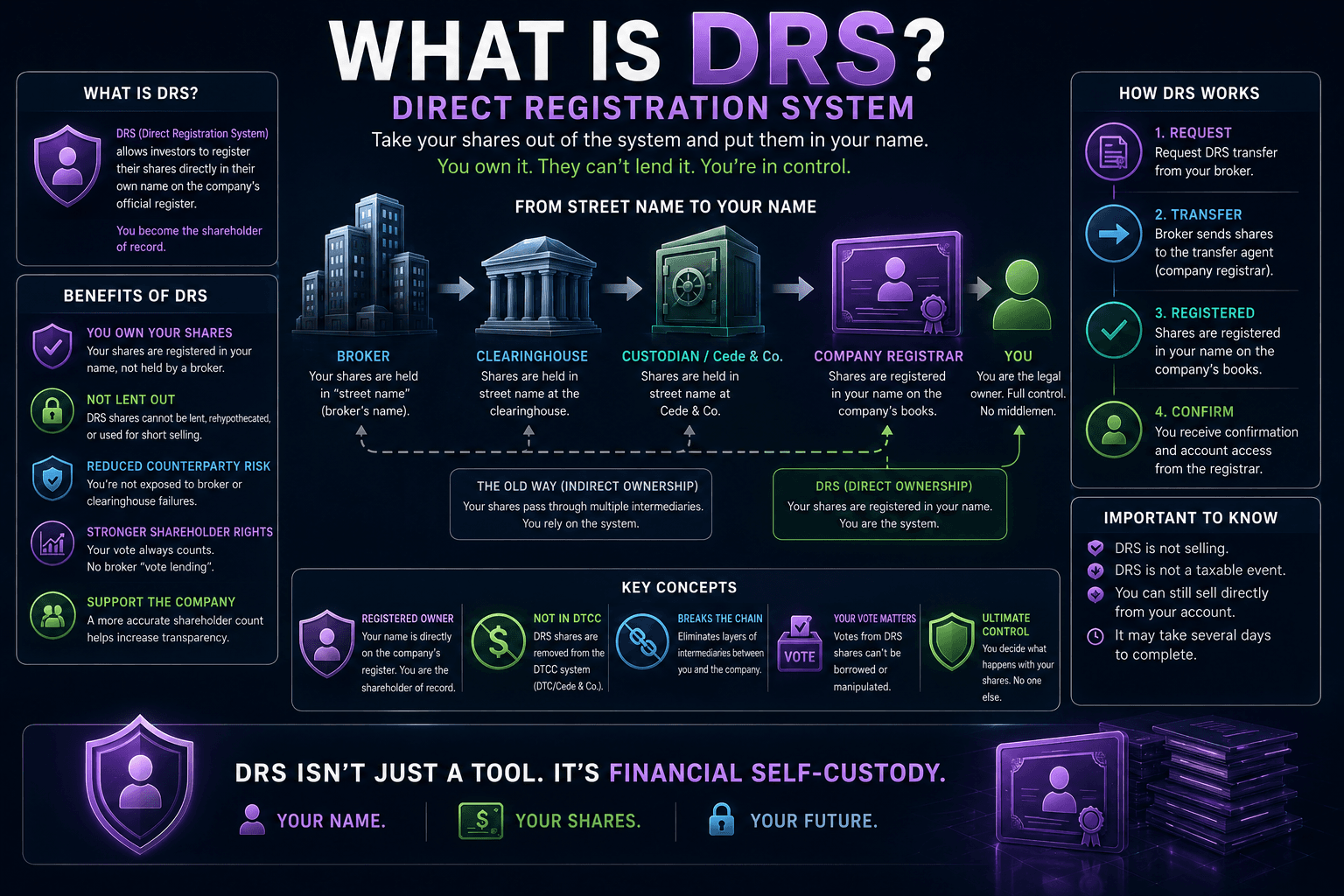
What Is DRS?
A clear, balanced guide to the Direct Registration System: how shares are normally held in street name, what it means to register directly in your own name, the genuine benefits and real trade-offs, and how to think about it.
Ironclad Research provides educational content only. Nothing on this platform is financial advice, a recommendation, or an offer to buy or sell any security. Always do your own research and consider professional advice before making financial decisions.