401(k)
The US workplace retirement plan: what a 401(k) is, how pre-tax (and Roth) contributions work, why an employer match is free money to claim first, how tax-deferred growth compounds, contribution limits, vesting, and the rules around accessing the money.
Written by James Lipyeat · Founder, Ironclad Research
Reviewed 23 July 2026 · Editorial policy
Before this, read
Introduction
For most American workers, the single most powerful wealth-building tool isn't a hot stock or a clever trade — it's a workplace retirement account called the 401(k). Named after a section of the US tax code, it lets you invest part of your paycheck for retirement with significant tax advantages, and often comes with free money from your employer attached. Using one well is one of the highest-impact financial decisions an ordinary person can make.
This lesson explains what a 401(k) is, how pre-tax and Roth contributions work, why the employer match should usually be claimed before anything else, how tax-advantaged growth compounds over a career, and the key rules — contribution limits, vesting, and access — you need to understand. (Tax rules are US-specific and can change; this is education, not tax advice.)
Quick Definition
A 401(k) is an employer-sponsored US retirement account that lets you invest a portion of your pay with tax advantages — and often with matching contributions from your employer.
The crucial idea is that a 401(k) is not itself an investment — it's a tax-advantaged container you put investments into, much like a wrapper around your retirement savings. Inside it, your money grows shielded from annual taxes, and depending on the type, you get a tax break either when you contribute or when you withdraw.
How A 401(k) Works
You sign up through your employer and choose a percentage of each paycheck to contribute. That money is automatically deducted and invested in options the plan offers — typically a menu of mutual funds or target-date funds (see What Is An ETF? for the low-cost, diversified fund idea). From then on, everything that happens inside the account is sheltered from annual taxes: no tax on dividends, interest, or gains as your investments grow year after year.
There are two main flavors, defined by when you get the tax break:
- Traditional (pre-tax) 401(k) — contributions come out before income tax, lowering your taxable income today. The money grows tax-deferred, and you pay ordinary income tax when you withdraw in retirement. You get the tax break now.
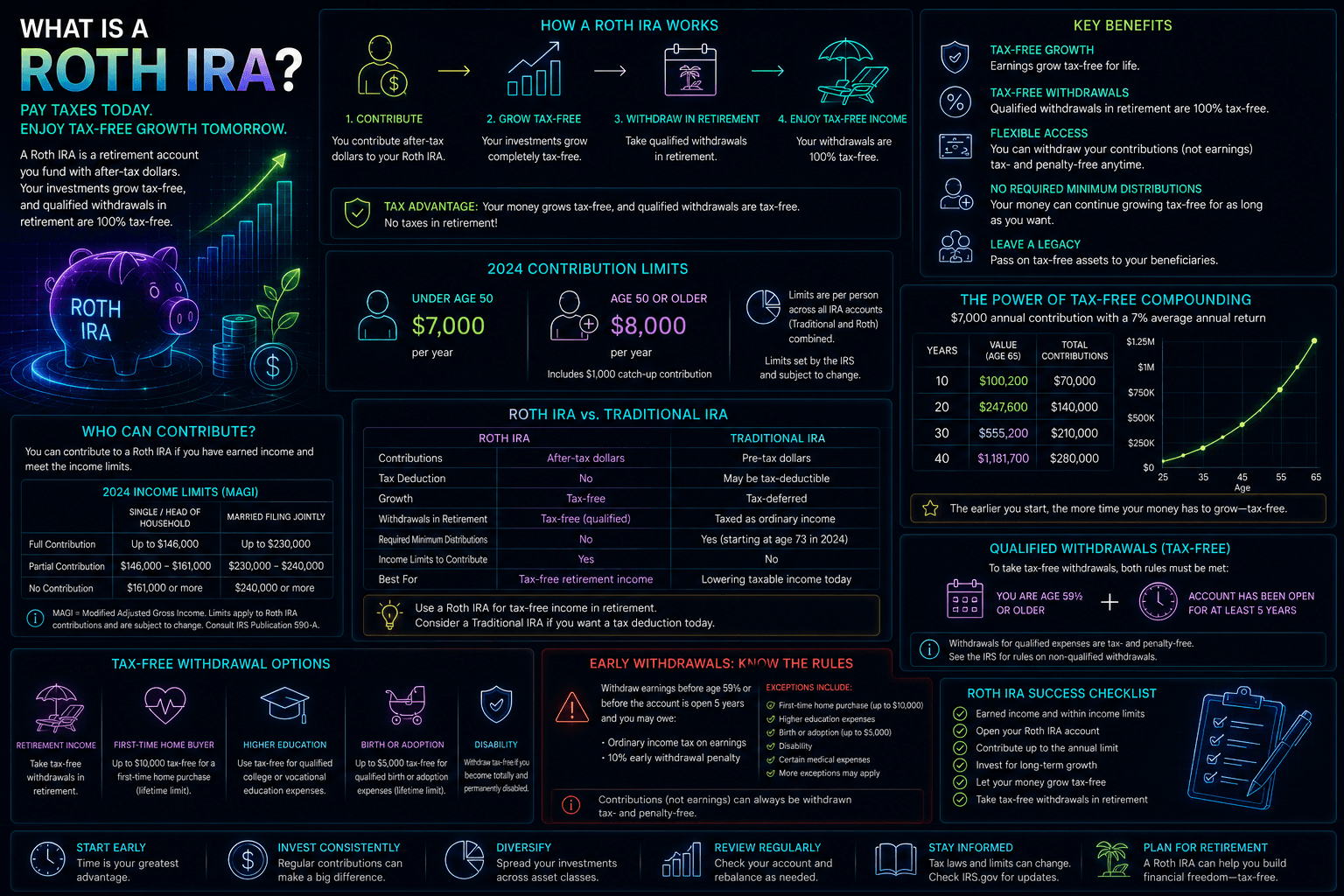
- Roth 401(k) — contributions come out of after-tax pay (no break today), but qualified withdrawals in retirement are completely tax-free, including all the growth. You get the tax break later.
Both are excellent; the choice depends largely on whether you expect to be in a higher or lower tax bracket in retirement (explored more in Roth IRA). Many plans let you split contributions between the two.
The Employer Match: Free Money
The defining feature of many 401(k) plans is the employer match. Your employer contributes extra money to your account based on how much you contribute — for example, "50% of contributions up to 6% of your salary," or "100% up to 4%." The exact formula varies by employer.
This is, quite literally, free money — an immediate, guaranteed return you cannot get any other way. If your employer matches dollar-for-dollar up to a point, every dollar you contribute (up to that point) is instantly doubled before it's even invested.
The practical rule that follows: contribute at least enough to capture the full match before doing anything else with your investing money. Leaving match on the table is leaving part of your compensation unclaimed. Even if money is tight, the match makes the 401(k) the highest-value place for your first retirement dollars.
Tax-Advantaged Growth Over A Career
The second source of a 401(k)'s power is tax-advantaged compounding. In a regular taxable brokerage account, taxes nibble at your returns along the way — on dividends, and on gains when you sell — and each dollar lost to tax is a dollar that no longer compounds. Inside a 401(k), the full return compounds, year after year, untouched until retirement.
The effect is the same compounding magic described in Compound Growth, but with tax drag removed. Over a thirty- or forty-year career, sheltering returns from annual tax can leave you with a dramatically larger balance than the identical investments held in a taxable account.
Contribution Limits And Catch-Up
You can't put unlimited money into a 401(k). The IRS sets an annual contribution limit on what you can defer from your paycheck, and it's adjusted periodically for inflation. Workers age 50 and older can usually add an extra catch-up contribution on top. (Employer match generally doesn't count toward your personal limit, though there's a separate overall cap.)
Because the figures change, this lesson deliberately avoids quoting exact dollar amounts — check the current year's limit rather than relying on an old number. The principle to remember is that the 401(k) offers a large, tax-advantaged space each year, and high savers aim to use as much of it as their budget allows.
Vesting: When The Match Becomes Yours
There's an important catch with employer contributions: vesting. Your own contributions are always 100% yours, immediately. But the employer's match may vest over time — you earn full ownership of it according to a schedule, and you can forfeit the unvested portion if you leave the company early.
- Cliff vesting — you become fully vested all at once after a set period (e.g., three years); leave before then and you keep none of the match.
- Graded vesting — you vest gradually (e.g., 20% per year), keeping a growing share the longer you stay.
Knowing your plan's vesting schedule matters when you're weighing a job change, since walking away just before a vesting milestone can mean leaving employer money behind.
Accessing The Money
A 401(k) is built for retirement, and the rules enforce that. Money is generally meant to stay invested until age 59½. Withdraw before then and you'll typically owe ordinary income tax plus a 10% early-withdrawal penalty, though specific exceptions exist (certain hardships, disability, and others). The penalty exists to discourage raiding retirement savings early.
Later in life, Traditional (pre-tax) 401(k)s require you to start taking Required Minimum Distributions (RMDs) — the IRS eventually wants its deferred tax, so you must begin withdrawing a minimum amount each year once you reach a set age. When you leave a job, you're not stuck: you can usually roll over your 401(k) into an IRA (see Traditional IRA) or your new employer's plan, keeping the tax advantages intact and often gaining more investment choice.
Putting It Together: A Priority Framework
A common, sensible framework for where your retirement dollars go — presented as education, not personalized advice — looks like this:
Risks & Considerations
- A 401(k) shelters tax, not market risk. Investments inside still rise and fall — the account protects from tax, not from losses.
- Investment choices are limited. You can only pick from the plan's menu of funds, which may have higher fees than a self-directed IRA.
- Early access is costly. The 10% penalty and taxes make pre-59½ withdrawals expensive; this is long-term money.
- Watch vesting before you leave. Unvested employer match can be forfeited if you change jobs too soon.
- Rules and limits change. Contribution limits, RMD ages, and penalties are set by law and can be altered; check current rules.
Common Misconceptions
- "A 401(k) is an investment." It's a tax-advantaged account you hold investments inside, not an investment itself.
- "The match isn't worth the effort." A match is an immediate, guaranteed return — usually the best deal in personal finance.
- "I'll lose my money if I change jobs." Your contributions are always yours; you can roll the account over. Only unvested employer match is at risk.
- "Roth and Traditional are wildly different accounts." They're the same kind of account with the tax break timed differently — now (Traditional) or later (Roth).
Real-World Application
Consider a worker earning a salary whose employer matches 100% of contributions up to 5% of pay. By contributing 5%, they don't just save 5% — they effectively save 10%, because the employer's match doubles it instantly. Invested in a low-cost, diversified fund and left to compound tax-deferred for thirty years, that combination of free match money plus untaxed growth produces a retirement balance far larger than the same paycheck percentage saved in a taxable account with no match. The worker didn't pick better investments or take more risk — they simply claimed the match and let the tax advantages compound. For most US workers, that is the everyday, career-long power of the 401(k).
Key Takeaways
- A 401(k) is an employer-sponsored US retirement account that shelters your investments from annual tax.
- Traditional (pre-tax) gives a tax break now and taxes withdrawals later; Roth is funded after-tax and gives tax-free qualified withdrawals.
- The employer match is free money — contribute at least enough to claim the full match before anything else.
- Tax-advantaged growth compounds powerfully over a career, just like compounding with the tax drag removed.
- The IRS sets an annual contribution limit (with catch-up for those 50+); the figures change, so check the current year.
- Vesting governs when employer match becomes fully yours; your own contributions are always 100% yours.
- The money is for retirement: age 59½, a 10% early-withdrawal penalty, and later RMDs shape when you can access it.
Finished this lesson? Track your progress.
Frequently asked questions
What is a 401(k) and how does it work?
A 401(k) is an employer-sponsored US retirement account that lets you invest part of your paycheck with tax advantages and often with matching contributions from your employer. You sign up through your employer, choose a percentage of each paycheck to contribute, and that money is automatically deducted and invested in options the plan offers—typically mutual funds or target-date funds. Everything that happens inside the account is sheltered from annual taxes, so dividends, interest, and gains grow without being taxed each year.
What is the difference between a Traditional and Roth 401(k)?
A Traditional (pre-tax) 401(k) lets you contribute before income tax, lowering your taxable income today, and you pay ordinary income tax when you withdraw in retirement. A Roth 401(k) uses after-tax pay (no tax break today), but qualified withdrawals in retirement are completely tax-free, including all the growth. Both are excellent; the choice depends largely on whether you expect to be in a higher or lower tax bracket in retirement.
Why is employer match considered free money?
Employer match is free money because your employer contributes extra money to your account based on how much you contribute—for example, 50% of contributions up to 6% of your salary or 100% up to 4%. This is an immediate, guaranteed return you cannot get any other way; if your employer matches dollar-for-dollar, every dollar you contribute is instantly doubled before it's even invested. Claiming the full match should almost always be your first priority, as leaving it on the table means leaving part of your compensation unclaimed.
How does tax-deferred growth in a 401(k) create wealth over time?
In a 401(k), the full investment return compounds year after year without being taxed annually, whereas in a regular taxable account, taxes nibble at returns through dividends and capital gains taxes—and each dollar lost to tax is a dollar that stops compounding. Over a thirty- or forty-year career, sheltering returns from annual tax can leave you with a dramatically larger balance than the identical investments held in a taxable account.
What happens to your own contributions and employer match when you leave a job?
Your own contributions are always 100% yours immediately and are not subject to vesting rules. However, employer contributions are subject to **vesting**, which means there's a waiting period before the employer match becomes fully yours—the exact vesting schedule depends on your employer's plan rules.
Key terms
Next lesson
Continue learning
Traditional IRA
Related topics
Ironclad Research provides educational content only. Nothing on this platform is financial advice, a recommendation, or an offer to buy or sell any security. Always do your own research and consider professional advice before making financial decisions.