Exchanges and Trading Venues
Follow an order from broker to execution, read a two-sided order book, and distinguish a share's listing exchange from the place it actually trades.
Written by James Lipyeat · Founder, Ironclad Research
Reviewed 4 October 2026 · Editorial policy
Before this, read
What you will learn
An exchange is an organised marketplace with rules for admitting participants and handling trading interest. A trading venue is the broader idea: somewhere orders or quotations can interact to produce executions. Your broker is the intermediary through which you submit instructions. These functions are connected, but they are not interchangeable.
This lesson teaches general mechanics. NYSE, Nasdaq and US broker routing are explicitly US market examples, verified on 4 October 2026. They explain markets that people around the world may study; they are not statements about the rules in every reader's country. Prices, quantities and companies in the calculations are invented. All examples exclude fees unless stated. This is financial education, not a recommendation to trade or select a particular venue.
By the end, you should be able to follow an order, read a small order book, calculate an average execution price, and explain why a quote or a recent trade does not promise a fill. The market-structure overview introduces the wider system; this lesson concentrates on the point where orders become trades.
Listing and trading answer different questions
A listing establishes a relationship between an issuer and a listing marketplace. It concerns admission to that market and continuing listing requirements. An execution is a particular purchase and sale agreed at a particular price and quantity. A company can have a listing relationship with one exchange while its existing shares change hands elsewhere.
For the US equity example, FINRA describes traditional exchanges, alternative trading systems and off-exchange market makers as different execution destinations. That is why an app displaying a company's listing exchange does not, by itself, identify where your order was filled. Source: FINRA, Where Do Stocks Trade?; verified 4 October 2026.
Consider a fictional company, Northstar Components. Suppose its shares are listed on Exchange A. A seller already owns 100 shares and a buyer wants to acquire them. Their transaction can concern exactly the same security even if their brokers arrange execution through another permitted destination. The listing label identifies the security's market relationship; the execution report identifies a transaction.
Also distinguish the primary and secondary markets. In a primary issuance, an issuer sells securities to raise funds. In an ordinary secondary-market purchase, an existing holder sells to another holder. The cash paid by the buyer is not automatically a new contribution to the company. This distinction matters because an exchange's association with an issuer can otherwise make every stock trade look like a purchase directly from that business.
Neither a prestigious listing nor an execution destination certifies an investment's value. Listing standards, matching rules and business risk answer different questions. A venue can operate its procedures correctly while a listed company's prospects deteriorate. Understanding the machinery does not remove the uncertainty attached to the security.
Follow the instruction, then the trade
An order begins as an instruction: buy or sell, how many units, at what price constraint, and for how long. The broker checks whether it can accept the instruction and arranges routing or execution. The destination then processes eligible interest under its rules. A match produces an execution report. Clearing and settlement deal with the resulting obligations.
These stages explain common status messages. “Received” can mean the broker has the instruction. “Open” can mean some quantity is still working. “Partially filled” means only part has executed. “Filled” means the instructed quantity has executed, not necessarily that all later transfers have completed. Actual broker labels vary, so the transaction record is more informative than the colour of a notification.
A single order can produce multiple executions. If 100 shares trade in two pieces, there may be two prices, two timestamps and one weighted average on the summary screen. The original instruction and the resulting fills are different records. Confusing them can lead someone to compare a displayed order price with the wrong execution figure.
One organisation may perform several roles. A broker-dealer can handle customer instructions and also trade as principal, using its own account. That does not make “broker,” “exchange” and “market maker” synonyms. The useful question is which function it performs in this transaction and what obligations attach to that function.
Read the two sides of an order book
A bid is a price at which someone is willing to buy. An ask, also called an offer, is a price at which someone is willing to sell. In a simple uncrossed book, the highest bid is below the lowest ask. Their difference is the quoted spread. Quantities tell you how much interest is shown at each price.
Suppose the best bid is $49.98 and the best ask is $50.02. The quoted spread is $0.04 per share. The midpoint is ($49.98 + $50.02) / 2 = $50.00. Neither number says that a new order will execute at $50.00. The midpoint is a calculation, and the spread is a comparison between two quotes.
The book is a set of conditional opportunities, not a complete map of everyone's intentions. Participants may have undisplayed interest, orders on other venues, or intentions they have not submitted at all. Orders can arrive, execute or be cancelled. A screenshot freezes a changing system and can make its apparent certainty misleading.
The last traded price is different again. It records a transaction that already happened. If the last trade was $50.00 but the current ask is $50.02, the earlier print does not entitle a buyer to $50.00. A chart mainly records completed activity; a book records currently displayed interest within the feed's coverage.
Worked example: a 100-share buy across two prices
Use the asks in the figure. Assume a 100-share market buy reaches this book, every displayed share remains available, no competing order arrives, and no other venue or hidden order supplies a better price. These assumptions deliberately isolate the arithmetic; they are not a description of everything a real router does.
The first 60 shares execute at $50.02, costing $3,001.20. The remaining 40 execute at $50.05, costing $2,002.00. Total consideration is $5,003.20. Dividing by 100 gives an average execution price of $50.032 per share. The average can have more decimal places than either individual execution price.
Relative to buying all 100 at the original best ask, the extra cost is $5,003.20 − $5,002.00 = $1.20. Relative to the $50.00 midpoint, the difference is $3.20. Both calculations are correct, but they answer different comparisons. A statement about slippage or execution cost is incomplete unless it names its benchmark and includes or excludes fees explicitly.
Now change only the instruction: make it a buy limit at $50.02. In the same book, 60 shares can execute within that price constraint. The next 40 cannot execute at $50.05 without violating it. Depending on the order's duration and handling instructions, the remaining quantity may rest or cancel. Price protection does not create additional supply.
Finally, imagine the 60-share ask disappears before either order arrives. The calculation above is no longer a forecast of the fill. The market order may encounter a different price; the limit order may receive nothing. The example teaches how to account for known fills, not how to predict which liquidity will survive until arrival.
Market orders, limit orders and the execution trade-off
A market order seeks execution without specifying a maximum buying price or minimum selling price. A limit order adds that constraint. Neither is a universal answer: one exposes the instruction to changing available prices, while the other can leave it partly or wholly unexecuted. FINRA's US explanation distinguishes those characteristics and notes that limit execution is not guaranteed. Source: FINRA Order Types; verified 4 October 2026.
A limit price is a boundary, not necessarily the price actually paid. In a simplified example, a buy limit at $50.05 can execute against an available $50.02 ask; the higher limit does not force the buyer to pay $50.05. Likewise, a sell limit establishes a minimum. Describing every limit order as “an order that waits” misses immediately executable limit orders.
Duration is a separate instruction. An order might remain eligible for a session or have other timing conditions. A cancellation request is also a message that takes time to process; it should not be confused with confirmed cancellation. If an execution occurs before cancellation takes effect, a later change of intention does not undo the completed trade.
These details explain why evaluating an order needs more than its label. Quantity, price boundary, session eligibility, duration and routing all matter. The lesson is to interpret those fields accurately, not to prescribe an order type for a particular reader's circumstances.
Worked example: the price trades, but your limit does not
Assume a venue uses price-time priority for the eligible displayed orders in this example: better-priced orders come first, and earlier orders at the same price precede later ones. There are already 200 shares bid at $49.95 when your 100-share buy limit joins behind them. An incoming seller then sells 100 shares at $49.95.
The last trade now shows your limit price. Nevertheless, the earlier queue absorbed the entire incoming sell. There are still 100 shares ahead of yours, and your execution quantity is zero. If another seller trades only 50 shares, your order still receives nothing. If a subsequent seller supplies 80, the remaining 50 ahead can fill and then 30 of yours can fill, leaving 70 unexecuted.
The arithmetic is about allocation, not unfairness inferred from a chart. A nearby trade at $49.96 would prove even less: it is above your maximum buying price. And a trade reported from another venue does not, on its own, establish that your order was eligible to participate there at that moment.
This example assumes one specific allocation model. Order visibility, special order instructions and auction participation can change priority rules. To interpret a real execution complaint, the relevant evidence includes the order's acceptance time, destination, eligibility and execution record, rather than only a candle that touched the limit.
Continuous trading and auctions
Continuous matching processes eligible buying and selling interest as it arrives. An auction gathers eligible interest for a defined event and determines a price and allocations under its rules. A simple auction illustration helps distinguish demand from the last observed trade.
Imagine eligible auction buyers will purchase 100 shares at up to $10.05 and another 100 at up to $10.00. Sellers offer 100 at no less than $9.95 and another 100 at no less than $10.00. At $10.00, all 200 shares on each side are compatible, so 200 can trade. This invented example has an obvious volume-maximising price; real auctions need further rules for ties, imbalances and eligibility.
An auction therefore does not simply replay the final continuous-trading price. Its participant set and accumulated instructions can differ. A quoted indicative auction price can also change as orders change. “Indicative” is information about the evolving auction, not a final execution confirmation.
Opening and closing prices often refer to particular market events, so their construction matters when interpreting charts. Two feeds can label a field differently or use different sessions. Before comparing them, establish whether both represent the same security, venue event, timestamp and adjustment convention. A discrepancy is a question to investigate, not automatic evidence that either feed is fraudulent.
NYSE and Nasdaq: labelled US examples
NYSE example, verified 4 October 2026. The NYSE describes a market combining electronic activity and a trading floor, with designated market makers for its primary listings and opening and closing auctions. Its parity/priority explanation distinguishes priority for price-setting interest from allocation among eligible participants at a price. This is not simply the first-in-first-out example above. NYSE market description and allocation explanation.
Nasdaq example, verified 4 October 2026. Nasdaq describes its stock market's continuous execution model as price/time priority. It also operates Opening and Closing Crosses, which bring eligible interest together for those events. The continuous model and the auction procedures should be read separately; mentioning price/time does not specify every special order's treatment. Nasdaq market description and Opening and Closing Crosses.
The comparison gives meaning to the names without turning them into a ranking. An exchange group may operate multiple markets with different models. A company's listing, a venue's matching method, a market maker's obligations and an index bearing a similar name are four different subjects. “Nasdaq” in an index headline, for example, does not by itself describe the destination of an individual order.
Routing, incentives and the limits of a quote
US routing example, verified 4 October 2026. Investor.gov explains that a broker can route to an exchange, market maker or electronic network, or execute internally. It describes best execution as a duty to seek the best execution reasonably available, with assessment of competing execution opportunities. This is not a guarantee that every submitted order receives the best price visible at an earlier instant. SEC Investor.gov: Executing an Order.
Routing decisions can interact with fees, rebates and commercial relationships. Those incentives warrant explanation, but a payment arrangement alone does not calculate the quality of a particular fill. The existing payment-for-order-flow lesson develops that specific topic. Here the distinction is between an incentive, an execution duty and a measured outcome.
Market liquidity means the ability to transact a quantity without an excessive price concession or delay. The quantity is essential: a book can look liquid for ten shares and shallow for ten thousand. Spread, depth and replenishment describe different aspects. The site's chart-focused Liquidity lesson uses another context; a chart label does not reveal all executable orders or prove where price must go.
Under changing conditions, displayed size can shrink, prices can move, and venues can apply pauses or other controls. A static book calculation leaves these events out so that one mechanism can be learned at a time. Its usefulness comes from explicit assumptions, not realism in every detail.
Reading a small execution record
An execution record becomes easier to understand when its fields are separated. Suppose the fictional order from the earlier example has an order quantity of 100, two fills of 60 and 40, an average price of $50.032, and no remaining quantity. The order quantity describes the instruction; the filled quantity describes what happened; the remaining quantity describes what is still eligible to happen.
Now suppose only the first 60 executed. Filled quantity would be 60, remaining quantity 40, and the average of the completed fills would be $50.02. Using the original order quantity as the denominator would give $30.012, which is not an average share price at all. That error mixes the cost of executed shares with the quantity of an instruction that has not fully executed.
The timestamp also needs a label. An instruction can be created in an app, accepted by a broker, routed, acknowledged at a destination and executed at different times. A screenshot taken between these stages is not necessarily a record of the market encountered at execution. Comparing two observations without aligning their times can make a normal change look like an arithmetic discrepancy.
Currency and fees form another pair of boundaries. A dollar execution price and an account statement converted into another currency are not directly comparable without the conversion terms. A fee-inclusive total is not the same field as a share price excluding commission. For the teaching examples here, keeping everything in dollars and excluding fees avoids those extra variables; a real record may include them separately.
A quote has a scope as well as a price
Consider a simplified two-venue snapshot. Venue A shows 30 shares offered at $20.00; Venue B shows 70 at $20.01. A data display showing only A can accurately report its best ask while leaving out B's available interest. A consolidated display can give a broader view, but it still has a timestamp, coverage and defined treatment of eligible quotations.
Assume an arriving instruction actually obtains 30 shares at $20.00 and 70 at $20.01. Its consideration is $600.00 + $1,400.70 = $2,000.70, or $20.007 per share. This is an accounting example across destinations, not a claim that every broker must route in this exact sequence. Fees, eligibility and changes during routing have been omitted deliberately.
If B's displayed interest vanishes, the same starting screen can precede a different result. If undisplayed interest executes at an improved price, the starting screen can also precede a better result. Neither possibility makes the snapshot useless: it means the observation should be described as a snapshot rather than as a contract for an unspecified future quantity.
This gives a practical reading habit for educational case studies. Name the security, side, quantity, destination coverage, timestamp, order conditions and cost convention before interpreting an apparent difference. The purpose is to make a claim testable. It is not to excuse an error or infer that a broker complied with every obligation without examining the records.
Put the pieces together
Suppose a fictional execution report says “100 bought, average $50.032,” while a screenshot shows a $50.02 ask and an exchange label. The first useful step is to separate the evidence: the label may identify the listing, the screenshot shows a quote at one time, and the report summarises actual fills. The two-level example provides one possible explanation, but does not establish what happened without the fill records.
That discipline prevents several overclaims. A tight spread does not guarantee enough size. A trade at a limit price does not guarantee every resting order filled. A fast notification does not prove settlement completed. A venue name does not certify the investment. Each observation is useful within its own scope.
Next, Market Makers examines the participants willing to quote and carry inventory. Then Clearing and Settlement follows the obligations after the price and quantity have been agreed. Together, the three lessons distinguish choosing to submit an instruction, obtaining an execution, and completing the resulting transfer.
Sources and revalidation
The linked SEC, FINRA, NYSE and Nasdaq pages above were checked on 4 October 2026. The regulatory and venue descriptions apply to the labelled US equity examples. They should be rechecked when routing guidance, allocation rules or auction procedures change. The examples and figures are original teaching calculations, not source quotations, transaction records or estimates of execution quality. No live spread, market-share figure or venue performance claim is asserted.
Finished this lesson? Track your progress.
Frequently asked questions
Is a listing exchange the only place a stock can trade?
No. Listing and execution are separate. In US equity markets, shares listed on one exchange can trade on other exchanges and through off-exchange venues or dealers.
Does a limit order guarantee a fill?
No. It constrains the execution price. Available size, queue priority, routing, order instructions and changing market conditions determine whether any or all of it executes.
Are NYSE and Nasdaq matching rules identical?
No. The venue examples verified on 4 October 2026 distinguish NYSE parity/priority allocation from Nasdaq's price/time model. Detailed order eligibility and auction rules must be checked for the particular market.
Is the last traded price an available buying price?
Not necessarily. It records a completed trade. The current ask, available quantity and competing orders determine the opportunities a new buy order encounters.
Key terms
Next lesson
Continue learning
Market Makers and Liquidity Provision
Related topics
Liquidity & Liquidity Sweeps
In market-structure trading, 'liquidity' means the resting orders — mostly stop-losses — that pool just beyond obvious swing highs and lows, and that price is drawn toward. This article explains buy-side and sell-side liquidity, why equal highs and lows are magnets, the liquidity sweep (or stop hunt) where price spikes through a level to trigger orders then reverses, internal versus external liquidity, and how this framing relates to the classic false breakout.
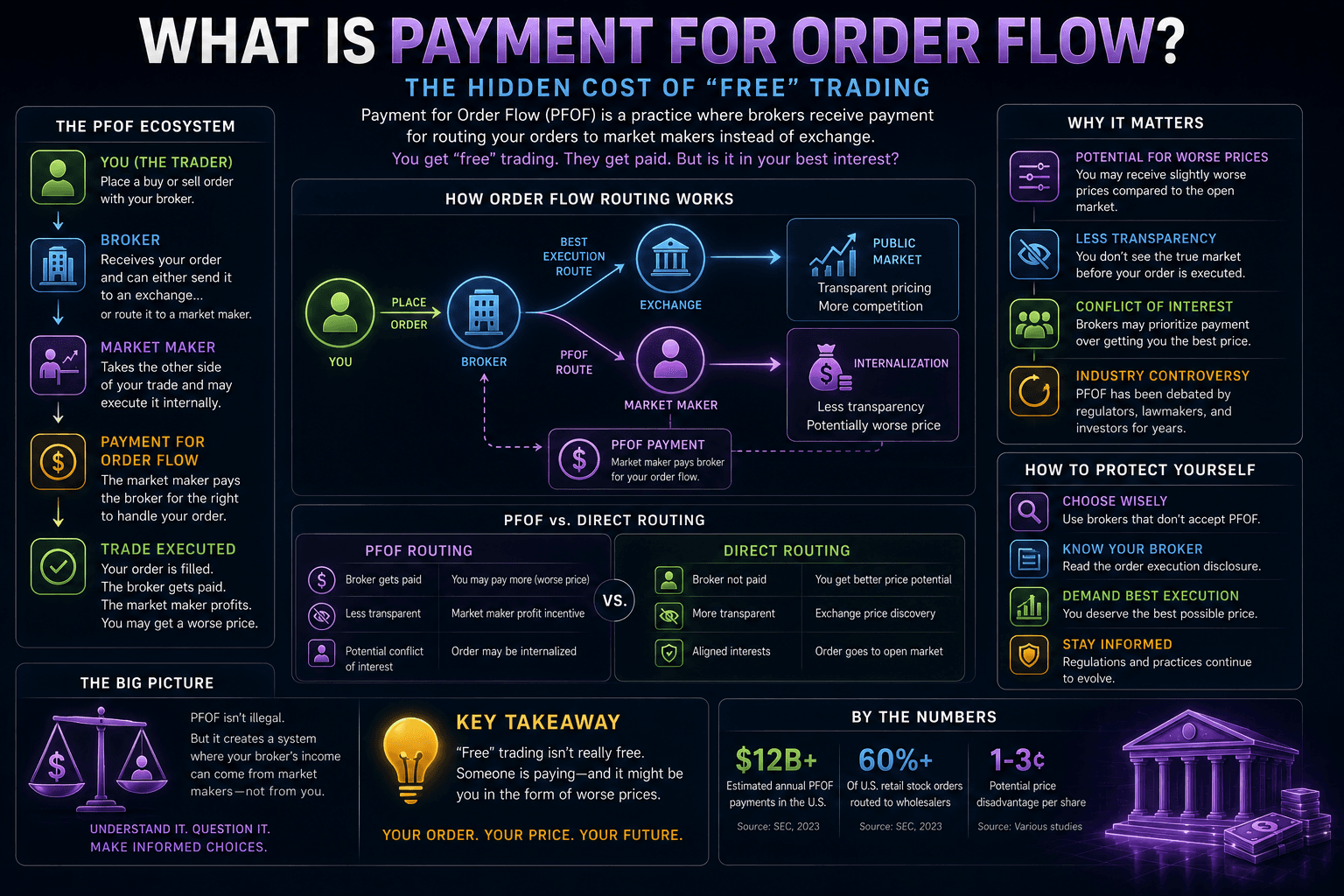
What Is Payment For Order Flow?
A balanced explanation of payment for order flow: how it funds commission-free trading, why market makers pay for retail orders, the conflict of interest it creates, price improvement and the NBBO, and what it means for you.
Ironclad Research provides educational content only. Nothing on this platform is financial advice, a recommendation, or an offer to buy or sell any security. Always do your own research and consider professional advice before making financial decisions.